The Scribe’s Advantage

Wise Dragons

Wise Dragon Statistics

Eleven dragons, four stages, five thousand years.
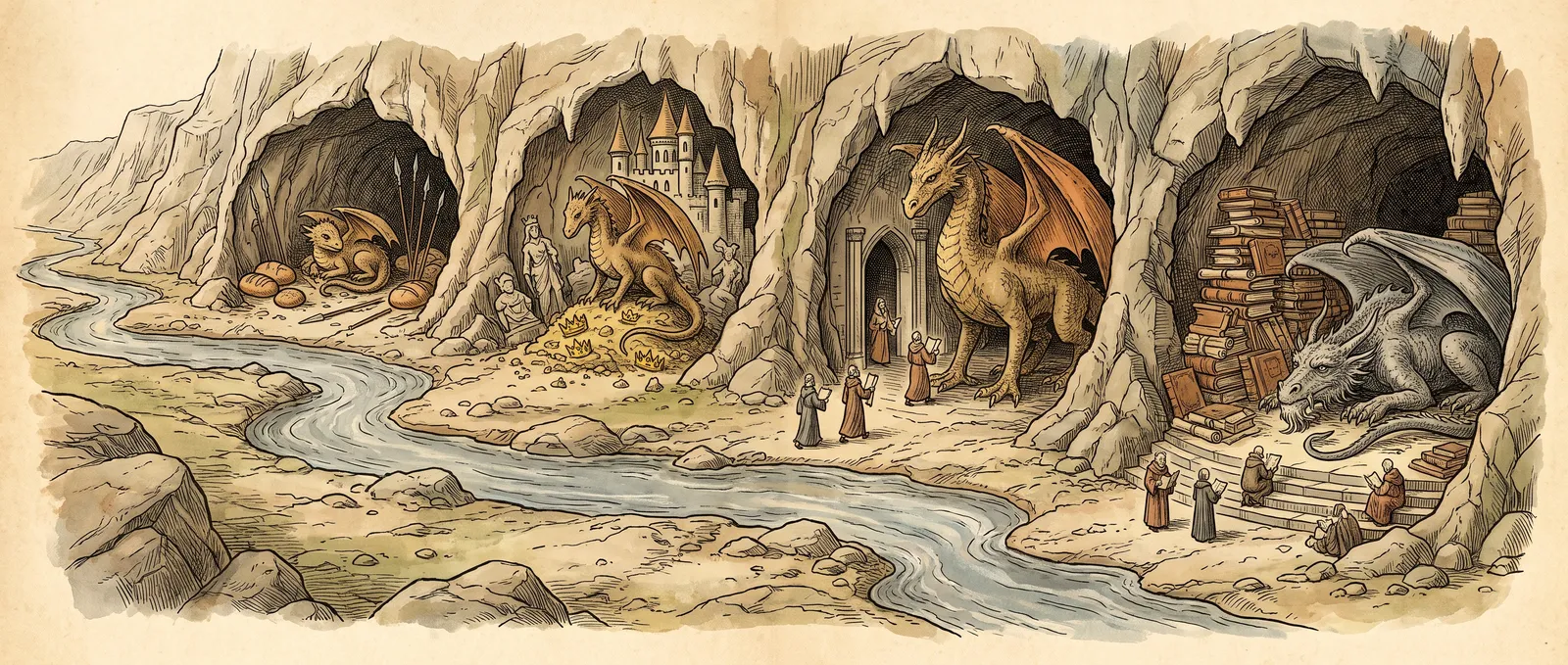
Wide plate of one river passing four cave mouths in a cliff: a hatchling curled on loaves and spears; a young dragon on gilt crowns under a castle; an adult at an open gate with robed scribes passing; a grey elder resting beside a tall stack of books while scholars read on the steps.
Four caves, four ages. One river, four caves: a hatchling on bread and spears, a young dragon on gilt, an adult at an open gate, and a grey elder beside the hoard. Full size

When each civilization crossed between the four dragon stages (baby, young, adult, wise elder) and what its hoard earned at every transition, clench, bite, regression, and recovery. The step-downs are real: stages run both ways.
BabyYoungAdultWise elder
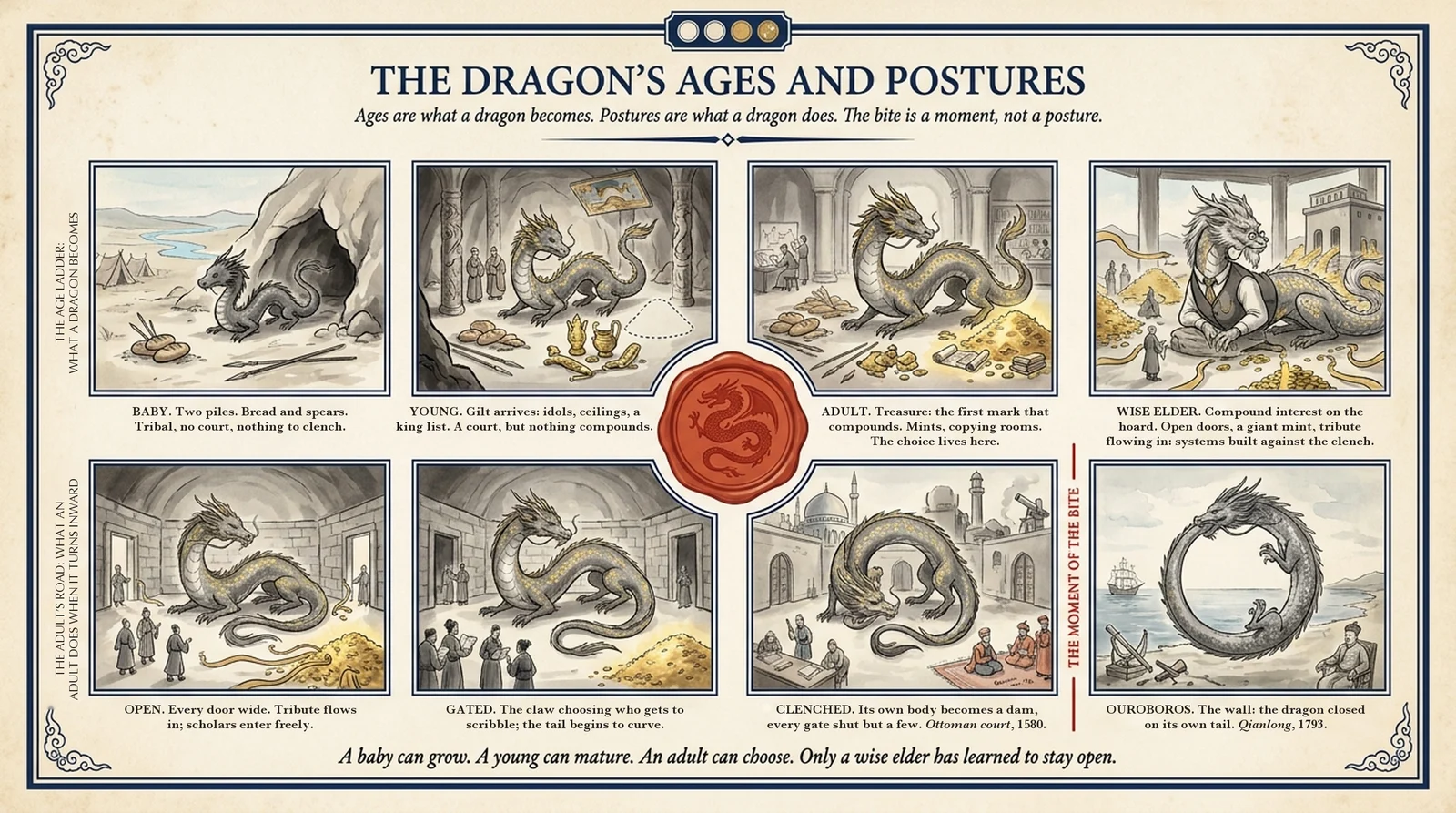
Four ages, as the book names them. Baby, young, adult, wise elder. Open, gated, clenched, ouroboros: the road an adult dragon travels as the hoard grows. The bite is the moment between the last two. Postures and the bite belong to an adult; they are not ages. The Dragon’s Hoard page carries the same vocabulary: the four ages, the adult’s road, and the six fates.
Figure 16: The Dragon’s Ages and Postures
Figure 16 · Ch 8The Dragon’s Ages and PosturesThe dragon’s ages and postures. Top row: the four ages Chapter 1 named. Bottom row: the adult’s road, the four postures. Open is where it starts: every door wide, tribute flowing in, scholars entering freely. Gated is the claw choosing who gets to scribble: the gate grows a keeper and the tail begins to curve. Clenched is the dragon curled so tight around its hoard that its own body becomes a dam: the Ottoman court, 1580. Then the red line, the moment of the bite: the bite is a moment, not a posture. And the ouroboros is the wall: the dragon closed on its own tail, Qianlong, 1793. A baby can grow. A young can mature. An adult can choose. Only a wise elder has learned to stay open.All plates in the Field Guide · Full size
The four stages (the piles read as ages; click to collapse)

Baby

bread + spears

Nothing outlives the counter.

Type specimen: Tasmania (Ch 6)

Young

+ gilt

Smelting yes, compounding no. May hold a script as a bread-pile tool.

Type specimen: the xenia palaces (Ch 1)

Adult

+ treasure (the mint)

The mint runs; the count outlives the counter, but the claw can close.

Type specimen: Uruk's crossing (Ch 1)

Wise elder

+ interest

compound interest on the four piles

Compound interest on an open, managed hoard: tribute in, harboring, standing self-disruption.

Type specimen: Britain, Orders in Council of 1855 and 1870 (Ch 17)

Clench, bite, and ouroboros are not stages. They are the adult’s disease. They render here as event markers and hatched regression bands over the adult band. Stages run both ways: the step-down is real.

  • Baby
  • Young
  • Adult
  • Wise elder
  • Regression / clench band
  • Dimmed = low/medium confidence
  • Dashed outline = years the book does not stage
  • ◆ Transition
  • ● Wisdom
  • ▲ Scar
  • ✦ Windfall
  • ○ Clench
  • ◎ Bite
  • ⊙ Ouroboros
  • ▼ Regression
  • △ Recovery
  • Checkbox adds a row to the treasure-rate comparison below. Click a row for the full ledger.
4000 BCE3000 BCE2000 BCE1000 BCE05001000150016001700180019002000axis compressed ← seam → expandedUK●✦●◆USA●▲✦◆○★ Japanthe surprise pick✦○✦◆▲●Germany✦●●▼△Singapore✦◆S. Korea◆●▼▲◆China●✦◎⊙●▲△◆○Iran●✦▲◆▼△○Turkeycontested◆●○△▼●○Indiacontested✦●◎●◆●Russiacontested▼◆●▼◎○△▼

Compound treasure rate

Is the hoard earning compound interest, or just sitting in the cave? Treasure minted per thousand carriers per generation, indexed against each era’s world ceiling.

Tick up to four rows on the timeline above (or use a preset) to overlay their compound treasure rates.