From the book
The Korea Transect
Papers, patents and centimeters across the 38th parallel
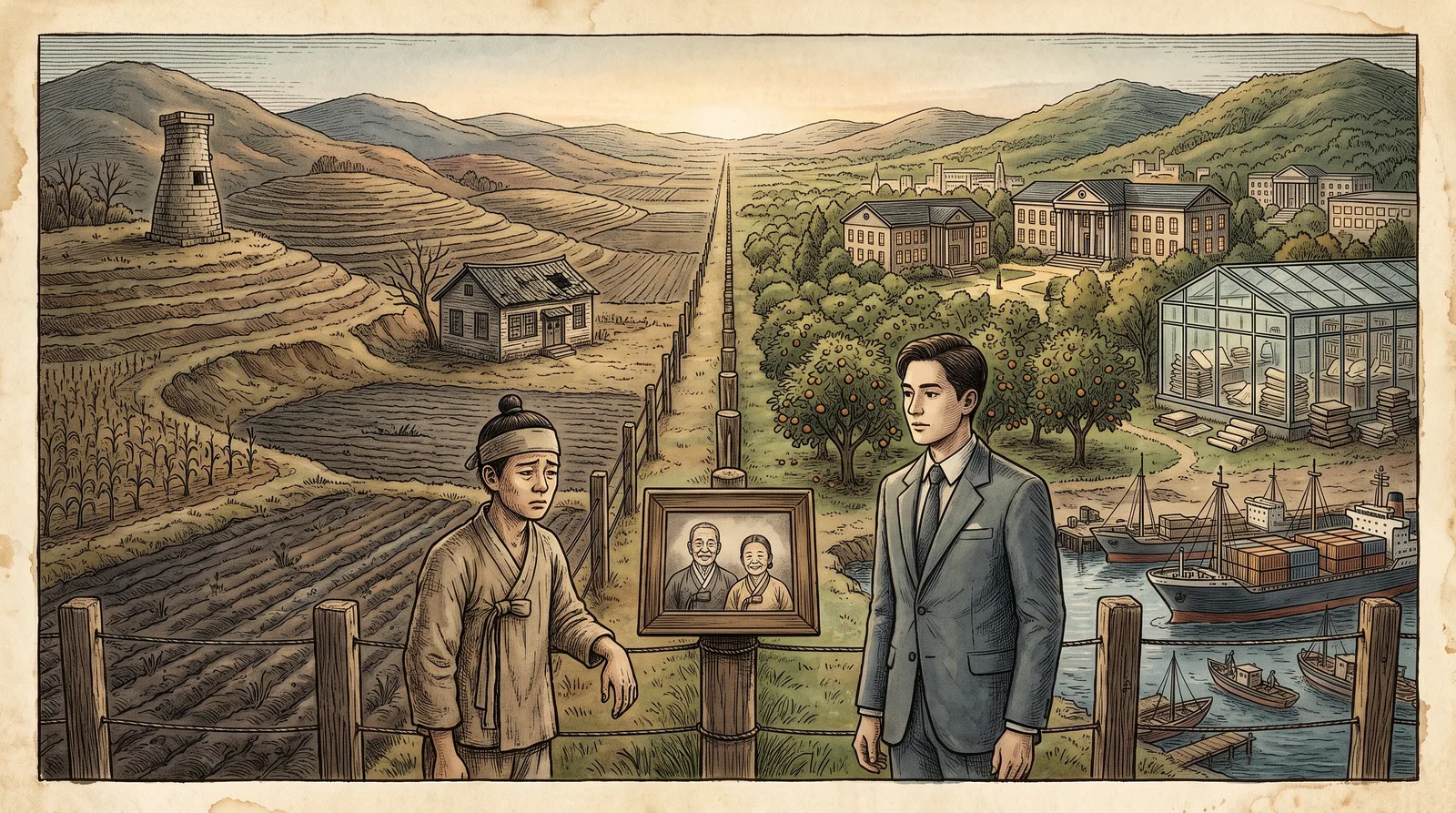
Korea is a transect. The line is the one the armistice drew in 1953, crossing the 38th parallel on a slant, the measurements are patents and publications and centimeters of skeletal growth, and the discontinuity at the boundary is as stark as any fence line in the Great Basin. Same people, same language, same grandparents. Two institutional structures. Two outcomes.
Supports Chapter 15, “Institutional Divergence.” The printed book points here for the detail it no longer carries.
Both sides of the line
| Measure | South Korea | North Korea | What the book keeps |
|---|---|---|---|
| Research money | Samsung’s R&D budget alone: about 35 trillion won (US$24 billion) in 2024 | Whole economy: Samsung’s 2024 R&D is about 79 percent of North Korea’s 2024 nominal GNI (44.4 trillion won, Bank of Korea estimate) | About four-fifths of North Korea’s entire economy |
| Papers | 80,000 to 90,000 peer-reviewed papers a year in Scopus-indexed journals | 2,554 Scopus documents in total, 1976 to 2024, not per year (1,344 domestic, 1,210 internationally co-authored) | Papers |
| Patents | Roughly 240,000 applications in a single recent year, more than 20,000 through the international system | About 7,000 applications in 2024, nearly all at home; 7 through the international system | Patents |
| Bone | Taller | Average young man 3 to 8 centimeters shorter; in adolescent cohorts the gap stretches to 11 | Centimeters of skeletal growth |
| Life | Life expectancy more than ten years longer | The book gives the gap, not a figure for the North | More than ten years longer |
| Caste | The book names no hereditary sorting in the South | Songbun sorts about 27 percent of the population into a hereditary underclass (the hostile class) | About twenty-seven percent |
The songbun underclass
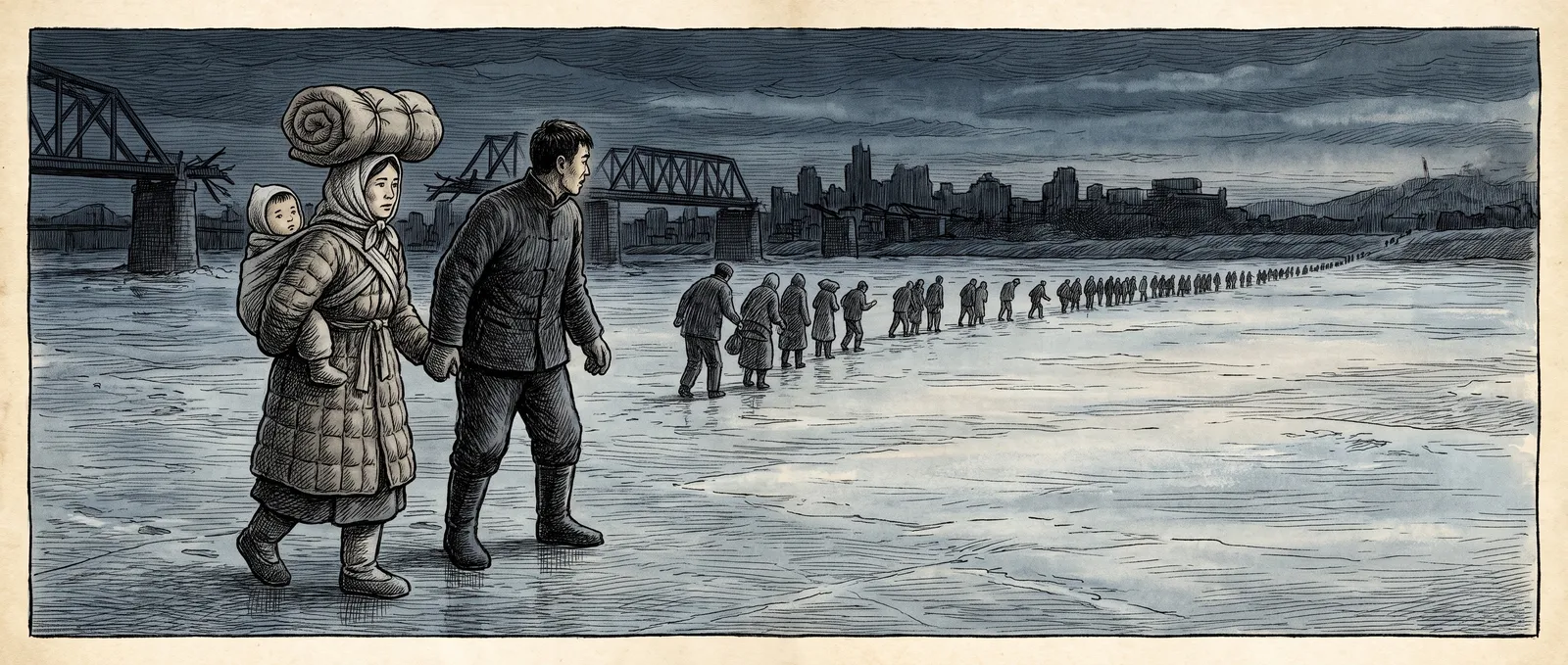
The songbun caste system that classified the woman on the ice as hostile class still sorts about twenty-seven percent of the northern population into a hereditary underclass whose children cannot attend university, cannot live in Pyongyang, and cannot hold professional positions. All three conditions, in ink that does not fade.
The height gap is not from genetics and not from disease. It is from nutrition, which is surplus.
Checking in progress. The songbun share, the North Korean paper count and the Samsung ratio are cited below, each to its source. The height gaps are the book’s figures and still wait for a cohort study to cite.