Methodology
How the Scoring Works
Four instruments tested against five thousand years of recorded history
What each one measures, how it is scored, and the images the chapters use to carry the argument. This is the methodology appendix.
- 1. Four axes
- 2. Capture matrix
- 3. Silt and salt
- 4. Six fates
- 5. Metaphor system
1. The four axes
Every region, every century, four numbers, one prediction. Each axis scores 0 to 3. When all four are elevated at once, the cave’s treasure compounds. When any axis collapses, the river dries, the cave overflows, or the banks give way.
Governmental stability
The geology that holds the riverbank.
0 unstable
1 partial
2 stable
3 deep-stable
Surplus
The volume of water in the river.
0 subsistence
1 marginal
2 sufficient
3 abundant
Carrier density
The current: how many trained people carry the canon.
0 none
1 few
2 moderate
3 high
Scribal output
The clarity of what the river carries.
0 none
1 minimal
2 substantial
3 prolific
The stability profiles use a finer 0-10 version of the same four axes.
2. The capture matrix
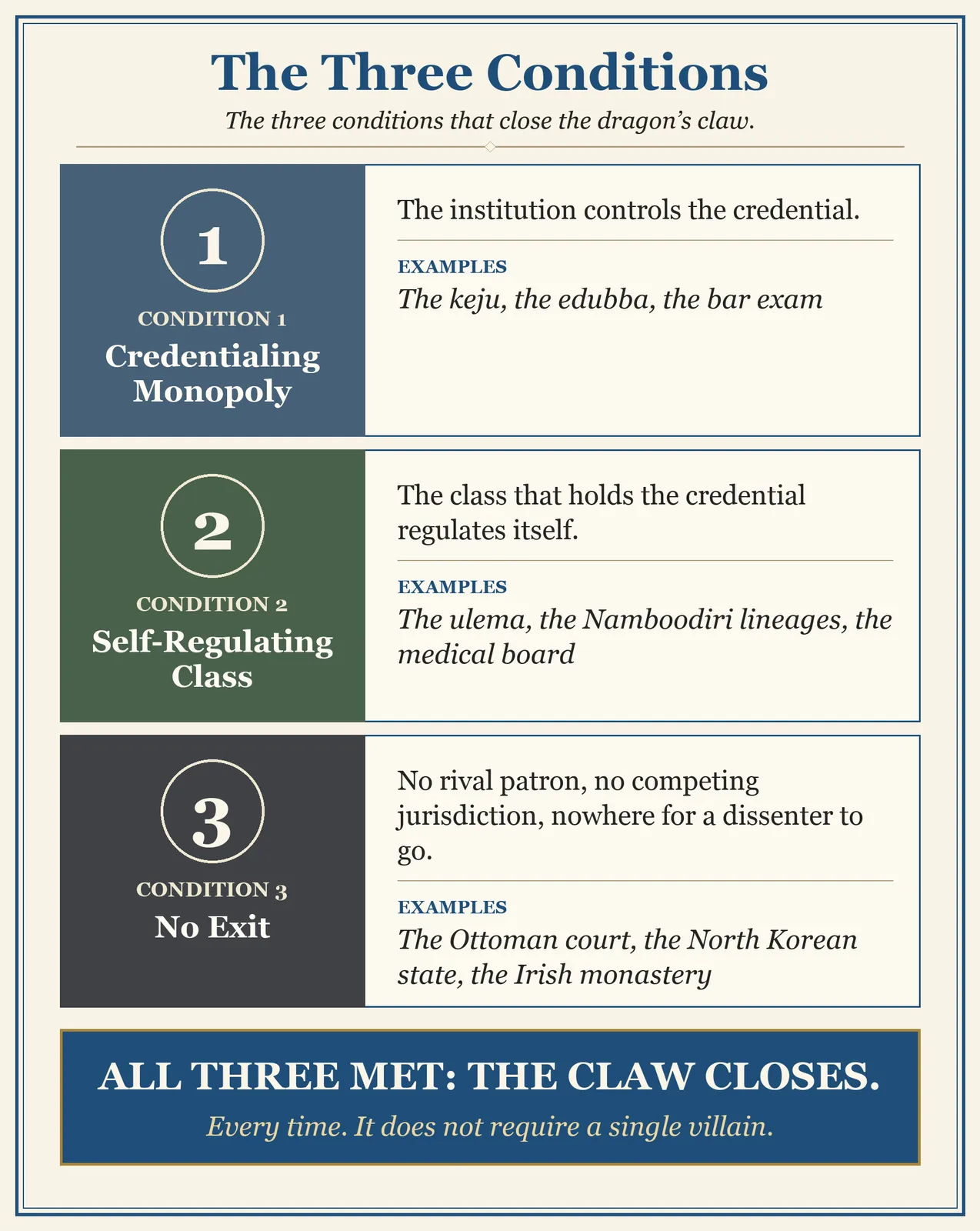
Three conditions that lock a scribal class in place. Each scores 0 or 1, with 0.5 where the condition is partial. The capture score is the sum. At 3 the class has no reason to produce anything new and nowhere for a rival to stand.
Credentialing monopoly
Is there one gate into the scribal class, and does the class hold the key?
The keju. The edubba. The bar exam.
Self-regulating class
Does the class set its own curriculum and grade its own work?
The ulema. The Namboodiri lineages. The medical board.
No exit
Is there nowhere else to go: no rival court, city, school or patron?
The Ottoman court. The North Korean state. The Irish monastery. Europe's fragmentation is the counter-case: always an exit.
3. Silt and salt: the silt to salt ratio
The whole flood is how much a scribal class writes: pages, filings, papers, posts. The silt is how much of that writing says something not already written. The rest is salt, ink with nothing new in it. Every compounding system starts with a strong flood and a high share of silt.
The crossing is the point where salt outruns silt: the class now produces more commentary on commentary than text about the world. The river keeps flowing, but the new ground it lays down (silt) falls behind the crust it leaves (salt). Read together, they are the silt to salt ratio. The book gives no crossing year for any profession: each crossing is a best-guess era, anchored where a measured series allows and argued against in the same breath. The pattern across every measured series, the waves, and the best guesses are on the Method page.
The two measures never share a plot with two axes. Both are indexed to a common 0-100 scale on one axis, as in the generic example here. The careers and their best-guess eras are on the Scribal Saturation page.
- The whole flood (index)
- Silt (index)
- Saturation crossing
Generic example. One axis, both series indexed 0-100. The dot marks the crossing.
4. The six fates
A dragon at full score does not last forever. The book found six endings in the record. The first is the only one that restarts compounding without losing the hoard.
1Tail spat out
The dragon reforms itself and releases what it was hoarding: the only voluntary fate on the list (Britain, by Order in Council, 1855 and 1870).
2Dragon slain
Something outside breaks the monopoly and kills the beast (Baghdad, 1258, in the better part of a week).
3Dragon scattered
The cave is shattered and the hoard flows downstream to other caves, carried by survivors holding whatever they can hold (Constantinople’s scholars to Italy).
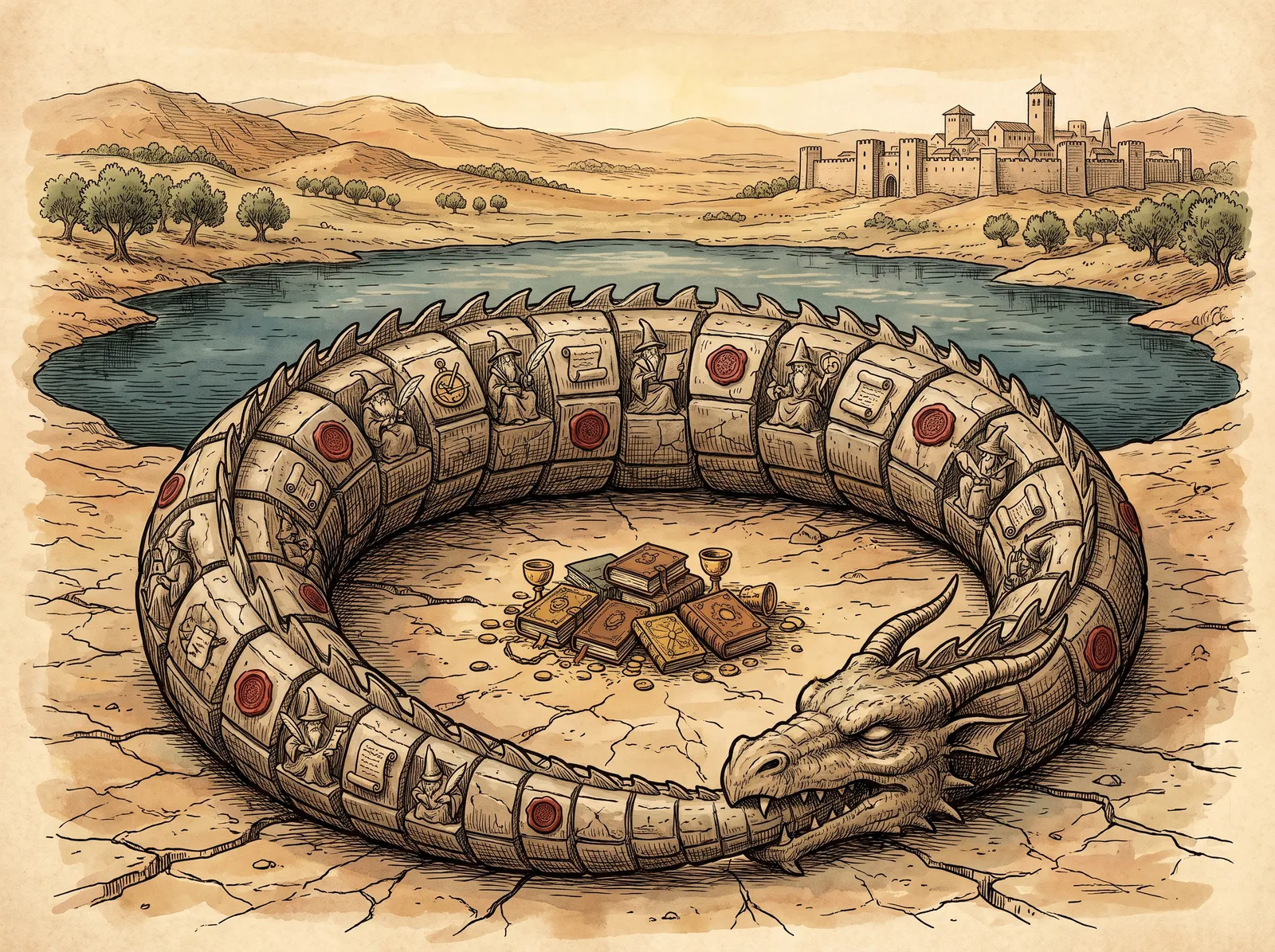
4Ouroboros
The default: the dragon choking on its own body while the cave fills with treasure nobody uses (the Ming after the bite of 1487).
5Cave overflowed
The river of carriers rises past what the banks can seat and the cave breaks from inside without anyone burning a thing (France, 1789).
6Cave colonized
An alien dragon moves in and replaces the hoard with its own (Cajamarca; the Rus, 1240).
5. The metaphor system
Five connected images carry the argument. Each is introduced through a story before it is named; the chapters earn the vocabulary before the measurements arrive.
The river
Surplus. It feeds the cave and it can be stolen: slavery is a diverted river, someone upstream pumping the water out.
The cave
Where the surplus piles up, and the ground the pile reaches: the territory one dragon sorts. Every surplus makes one; what grows inside depends on stability, surplus, carriers and output.
The dragon
The sorting system itself, born the first day the pile is bigger than the appetite. It is not a curse; the question is what it does with its claws. Three conditions close its claw, and an adult that clenches long enough bites its own tail. Clenched is the gate become a dam, letting through only a controlled trickle; the ouroboros is the wall, nothing through that is not already the dragon’s own.
The salt
Text about text that a slowing current leaves on the treasure as its water goes to the sun, until a reader standing above it concludes there was never any treasure down there at all. The whole flood rises; the silt in it falls. Salt is one of three sediments: muck (rule, precedent, credential) comes from the dragon and buries people; rot comes from time alone. Its opposite is silt, the fertile new ground a flood of new writers or a new machine lays down; the silt to salt ratio is the book's name for the balance.
The friction staircase
Every revolution in writing technology, alphabet to printing press to AI, softens the riverbank so the river carves faster. Each step drops the cost of entry.