Population × literacy
The Stolen River
How wide the water could have been, and what sat on top of it
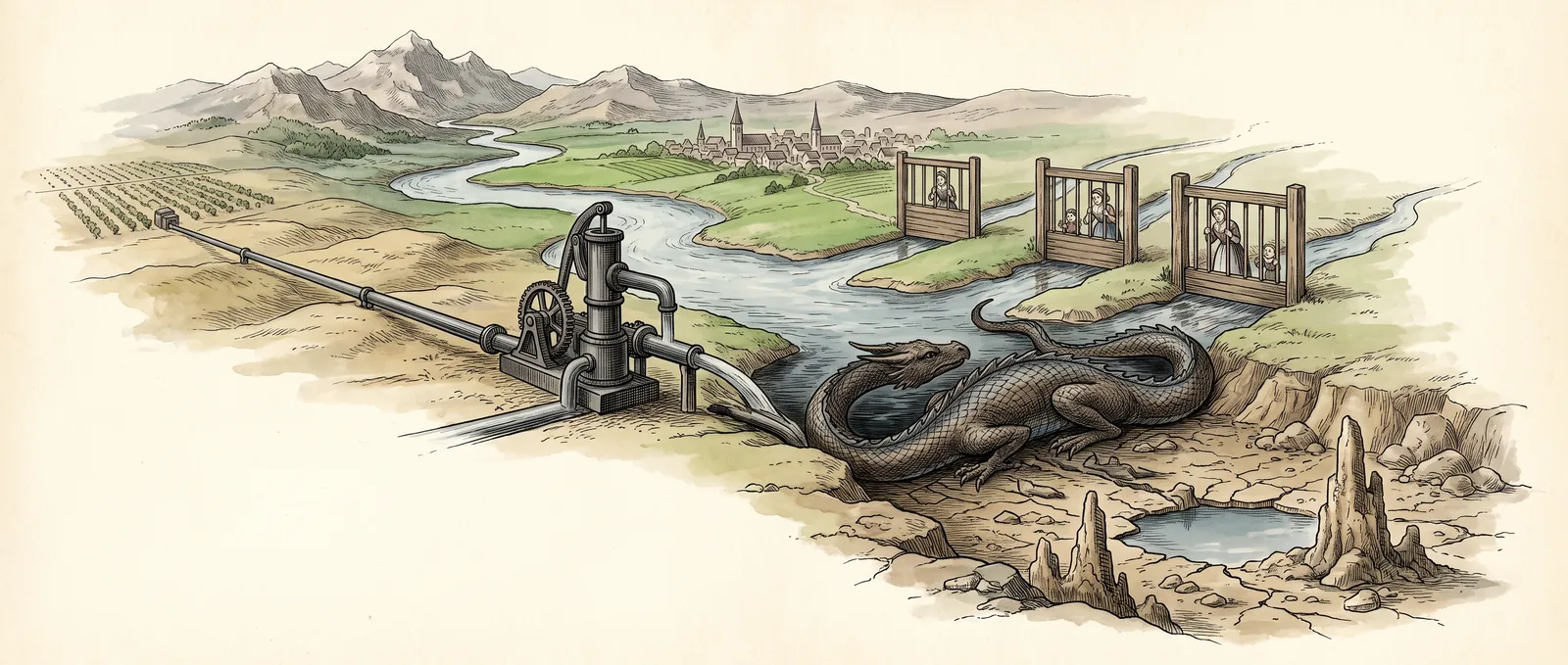
Total population is the river's theoretical volume. The scribe ratio is the discharge. Slavery pumps the water to someone else's field; gender and caste are gates set by birth; and clenched is the gate become a dam, letting through only a controlled trickle. The stolen-river score is the difference: additive to the potential, not a replacement for it.
Water level
Pre-modern literacy is scholarly estimate unless an anchor says otherwise. Hard numbers only where they are green. Literacy is not the same as an active scribe. From 1820 the literacy rate is the adult rate, the share of people aged 15 and over who can read, so the literate count multiplies it by the population aged 15 and over, not by everyone alive.
| Year | World pop | Aged 15+ | Literacy | Literate | What barred the carriers | Confidence |
|---|---|---|---|---|---|---|
| 3000 BCE | 15M | not separated | 0.03% | 5,000 | Friction (writing just invented) | GREEN/YELLOW |
| 1200 BCE | 75M | not separated | 0.5% | 375,000 | Friction, gender, class | YELLOW |
| 500 BCE | 150M | not separated | 2% | 3M | Gender, slavery, class | YELLOW |
| 1 CE | 250M | not separated | 5% | 12.5M | Gender, slavery, caste | YELLOW |
| 500 CE | 220M | not separated | 2% | 4.4M | Collapse, gender, feudalism | YELLOW |
| 1000 CE | 300M | not separated | 4% | 12M | Gender, feudalism, caste | YELLOW |
| 1450 CE | 425M | not separated | 8% | 34M | Gender, slavery, caste | YELLOW |
| 1700 CE | 640M | not separated | 12% | 77M | Gender, slavery at peak, caste | GREEN/YELLOW |
| 1820 CE | 1.04B | 0.67B | 12% | 80M | Gender, slavery, colonialism | GREEN |
| 1900 CE | 1.65B | 1.07B | 21% | 229M | Gender improving, colonialism | GREEN |
| 1950 CE | 2.5B | 1.63B | 36% | 585M | Gender narrowing, poverty | GREEN |
| 2000 CE | 6.1B | 4.30B | 81% | 3.49B | Poverty, regional exclusion | GREEN |
| 2025 CE | 8.2B | 6.22B | 87.7% | 5.46B | Poverty, quality gap, engagement | GREEN |
The stolen rivers: four ways (Figure 13)
A river can be stolen four ways, and the mechanism matters more than the theft (Ch 12).
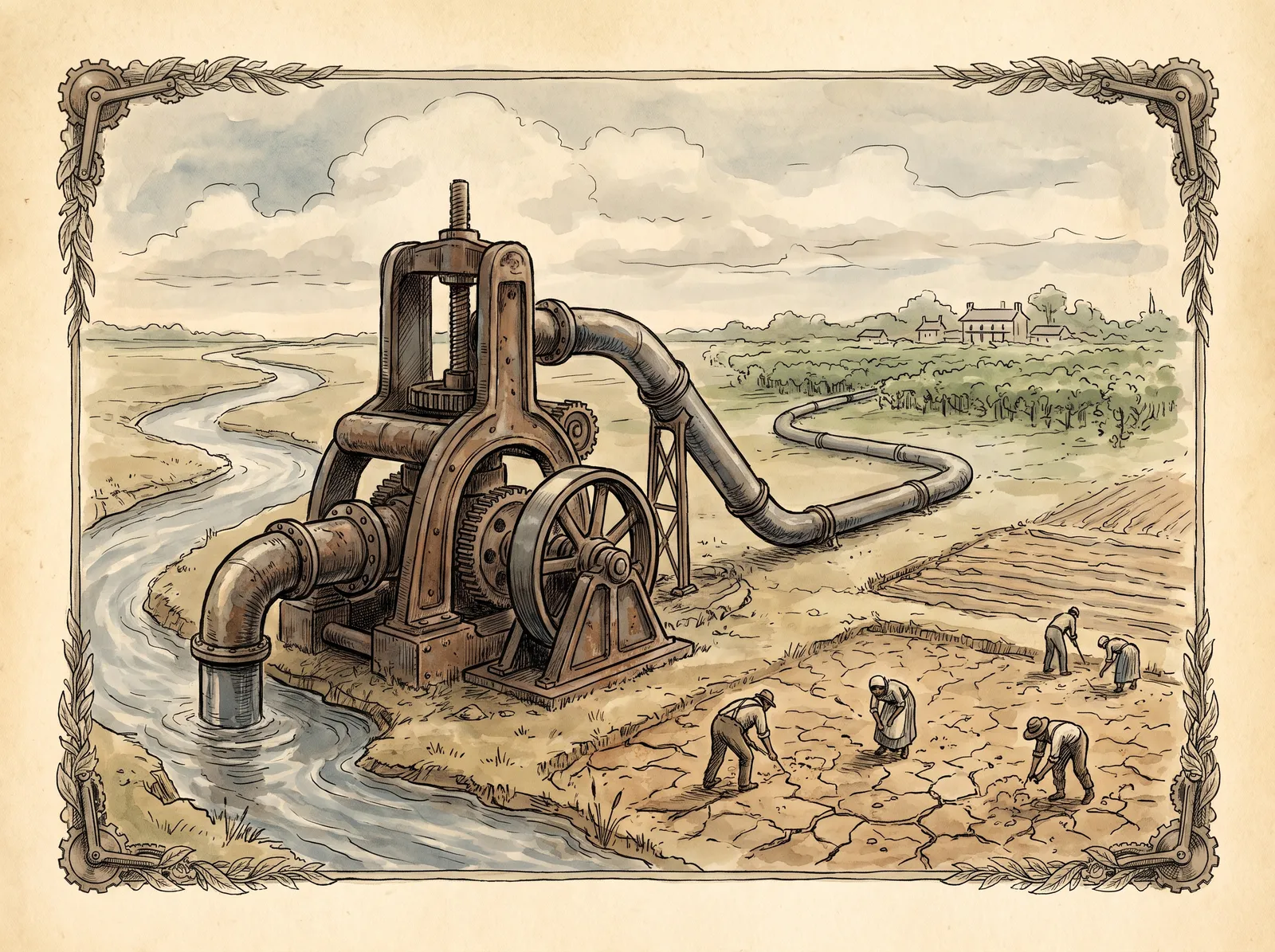
Slavery: the pump
The water pumped to someone else's field, the carrier forced to compound for the master.
Expulsion: the poisoned spring
It can be poisoned at the spring by the dragon's own decree, which is expulsion. A dragon can also expel its own by decree, and the source cave runs just as dry, with the dragon standing at the door to watch them go. Spain, 1492.
Trade diversion: the bypass
A new channel dug that bypasses the old one entirely, and the downstream cave starves without a soldier crossing its border.
The literal dam: Derby Dam
A pen stroke in Washington, and a lake in Nevada starts to fall. The Truckee was the only one that was not a metaphor.
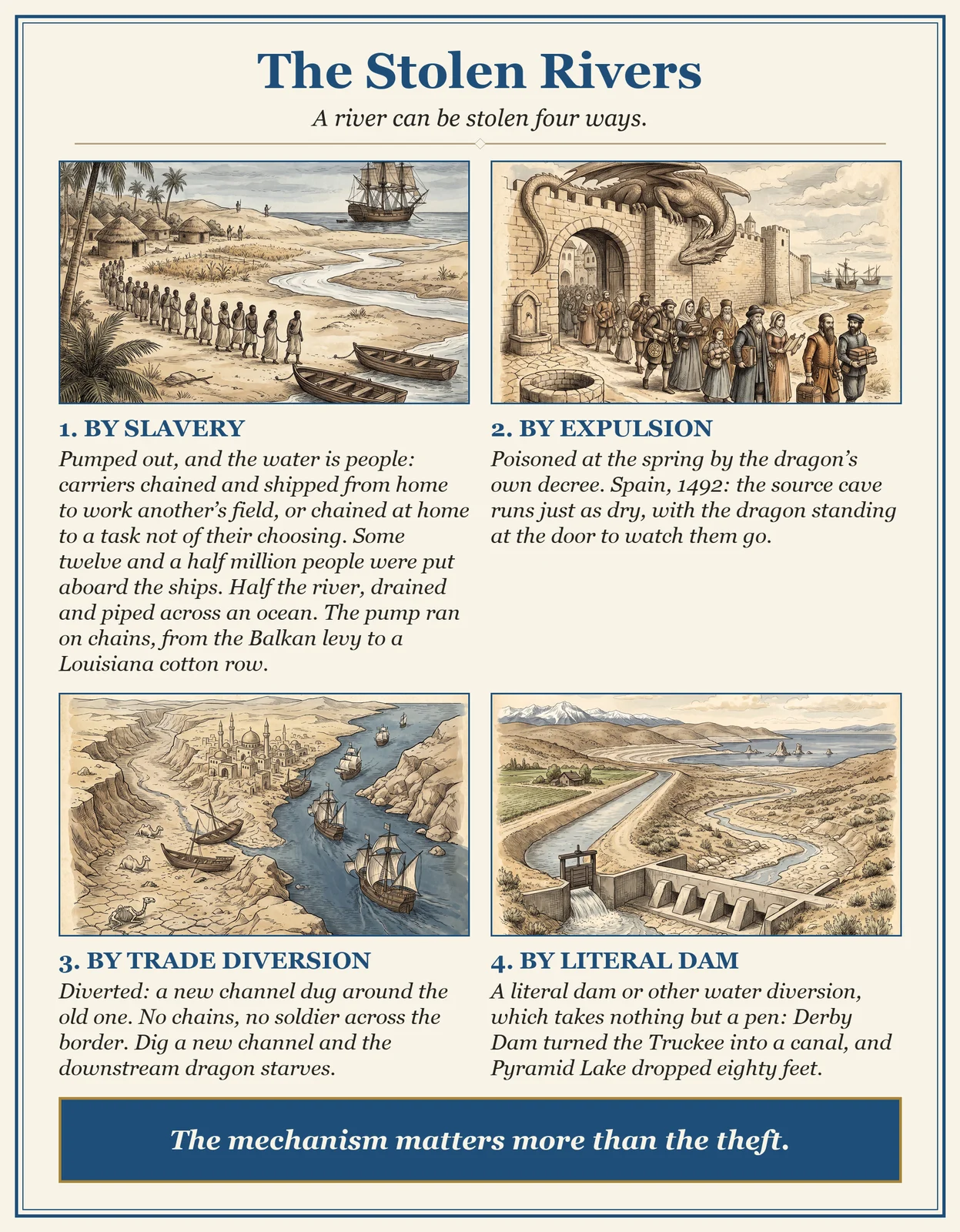
The stolen river: Pyramid Lake (Figure 14)
The only one of the four that was not a metaphor (Ch 12).
1902
Congress passes the Newlands Reclamation Act.
Derby Dam
One of the first projects built under that law diverts the Truckee River into a canal to irrigate farmland in the Carson Sink.
Over the next century
Pyramid Lake falls more than eighty feet. The Lahontan cutthroat trout goes extinct in the lake; the cui-ui is pushed to the edge of extinction.
1990
The settlement act: the inflection where the paperwork was finally answered with paperwork.
The salt is the receipt. Pyramid Lake rose from about 3.7 grams of salt a liter to about five as it fell (ILEC World Lake Database). Walker Lake, next door, dropped almost 160 feet between 1882 and 2010 as its dissolved solids went from 2,500 to 25,000 milligrams a liter (U.S. Geological Survey, Walker River Basin).
The fishery that had sustained the Paiute for millennia was destroyed by a piece of paper signed in Washington by a president who had never seen the lake. The measure of what a dam steals is the original shoreline, and that is the book’s measure for every dammed river of talent in the record.
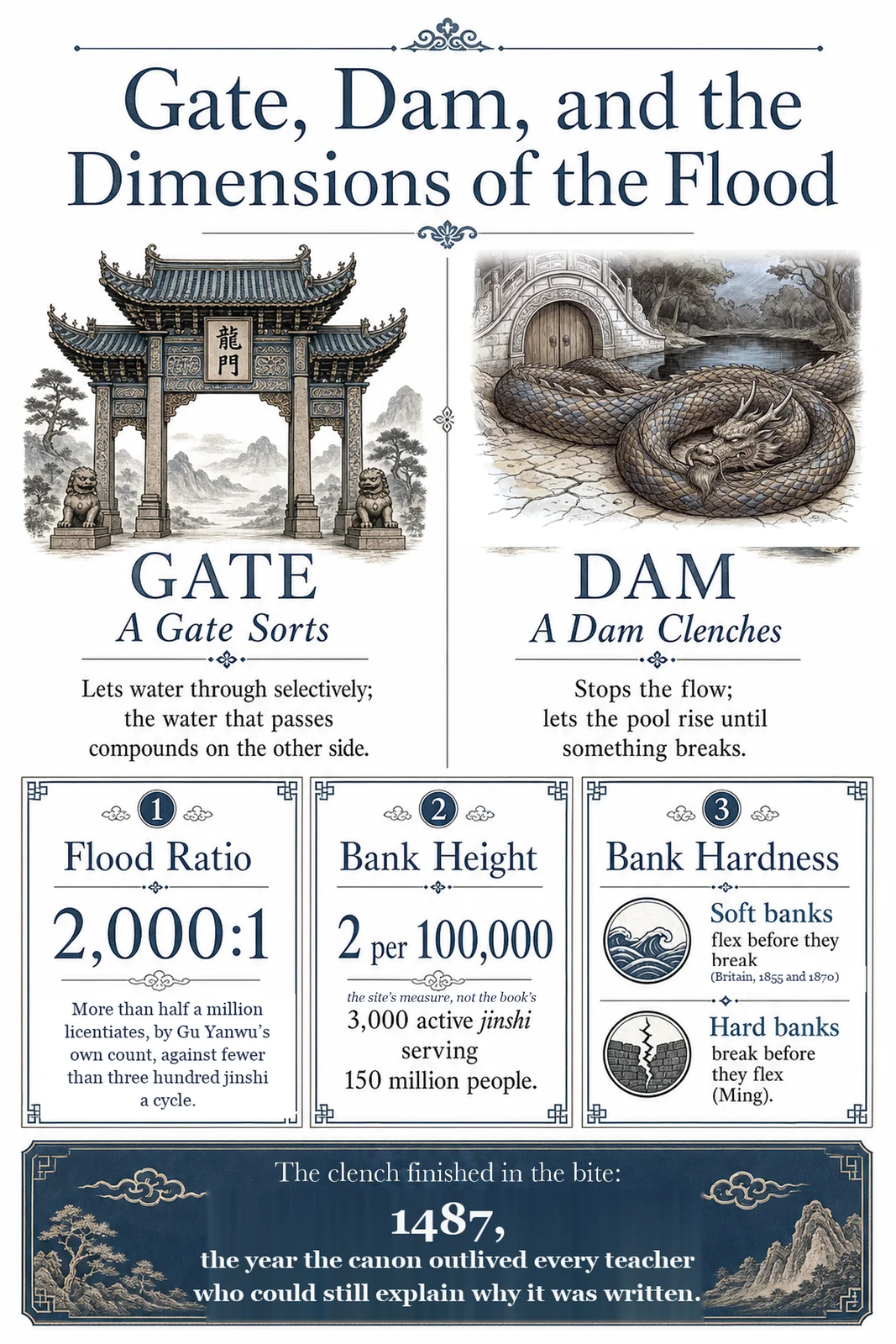
Gate, dam, and the dimensions of the flood (Figure 10)
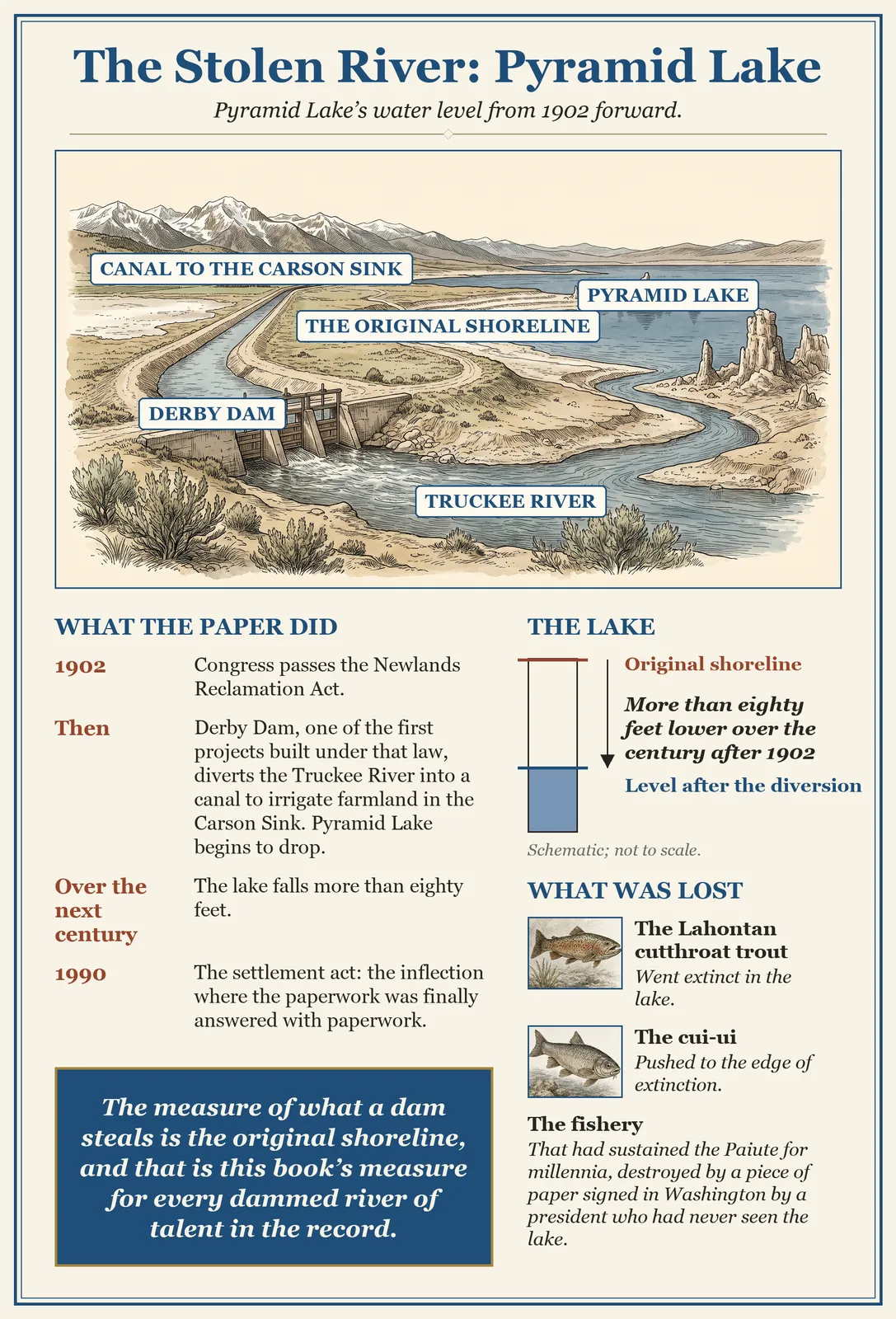
The gate and the dam are two states of one system. A claw that sorts works a gate: it lets water through selectively, and the water that passes compounds on the other side. Clench that claw on every gate long enough and it pulls the dragon’s whole body down across the river, and the dragon’s own body becomes the dam: the flow stops and the pool behind it rises until something breaks (Prologue; Ch 9).
Flood ratio
~1,800 : 1
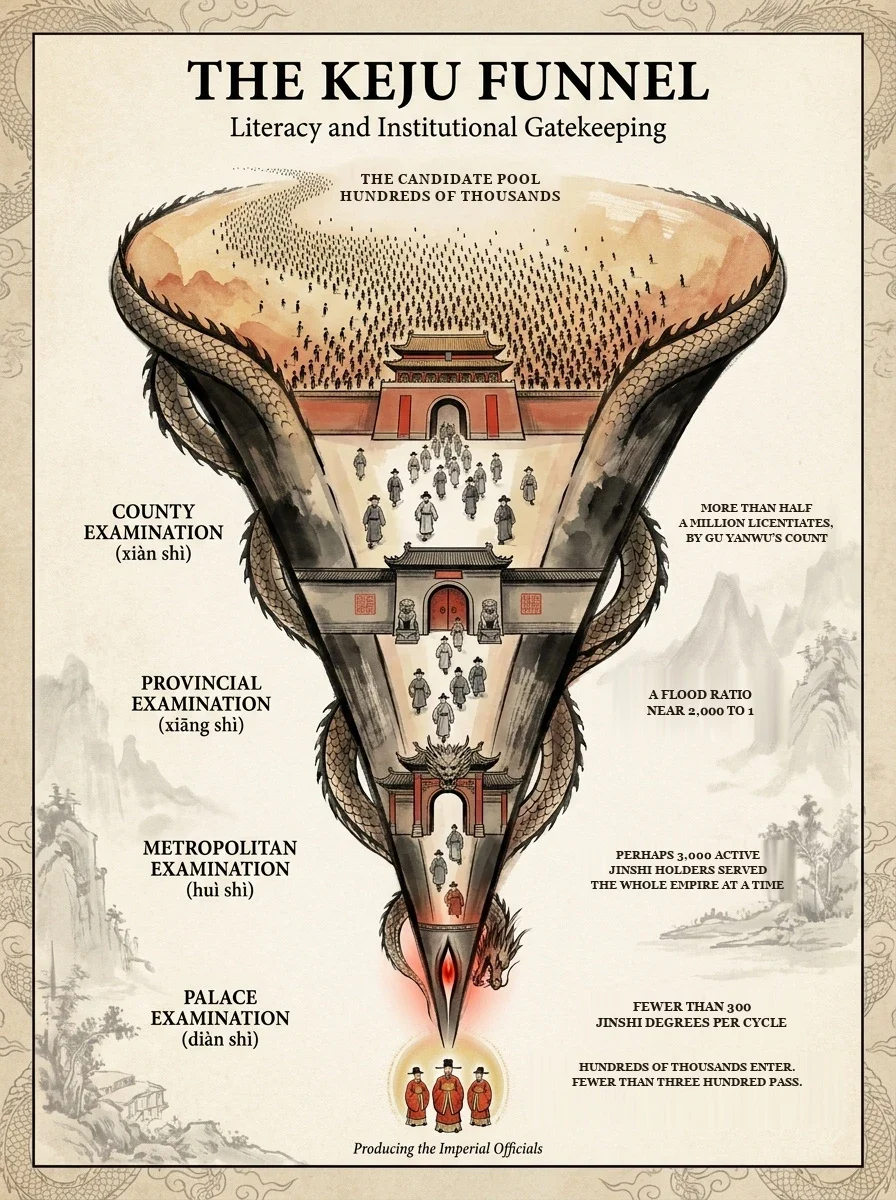
More than half a million licentiates (Gu Yanwu’s count) against fewer than three hundred jinshi a cycle under the Ming, about 276 a palace examination (24,594 in 89; Elman 2000, p. 650): the book’s “near two thousand to one,” the sharpest filter any civilization has ever run at scale.
Bank height
2 per 100,000
About 3,000 active jinshi serving 150 million people.
Bank hardness
Soft banks flex; hard banks break
Britain re-cut its banks by Order in Council, not by statute, in 1855 and 1870, and survived it. The Ming banks were hard, and hard banks break before they flex.
Then the clench finished in the bite. 1487, the year the canon outlived every teacher who could still explain why it was written (Ch 9).
Who got through the Ming funnel, and who was left outside it: China: The Blood and the Paper.
The working ledger: five cases of carriers barred
Never multiply a snapshot deficit by generations and call it a body count. A missing population in 1850 is a stock. The 5% knowledge-producer baseline is a modeling assumption, not a measurement, except the gender gate, which is an accounting identity at the 1820 rates.
Pumped out
Transatlantic slave trade / Africa Ch 12
10 to 15 million transported (slavevoyages). Anti-literacy laws: VA 1819, NC 1830, AL 1832, SC 1834.
If Manning's missing half is in range, 1850 snapshot is 2.5 to 5 million potential scribes at a 5% baseline. Do not multiply by generations.
Retired: ~80 million across 16 generations: stock counted as flow.
Siphoned
Ottoman devshirme / Balkans Ch 12
Structural: boys removed, converted, trained, placed at the center of the empire.
Commonly cited 200,000 to 300,000 cumulative, 14th to 17th c. Transfer between caves, not a subtraction from the species.
Locked to the dirt
Russian serfs 1861 Ch 12
>23 million privately owned serfs freed. ~38% of European Russia's population.
~1.15 million potential scribes in that generation at 5%. State peasants not in the 23 million. Thin leak: serf intelligentsia. Do not score ~10 million as a body count.
Sealed circuit
Hurrem / Ottoman harem Ch 19
Hurrem manumitted and married Suleiman, 1534. Sultanate of Women 1533 to 1656. Medrese admits no women.
A few hundred literate women in the palace; the empire's female half gated out. Knowledge compounds inside and is forbidden to become general.
Gender gate
Half the river Ch 19
OWID 1820: male literacy ~17%, female ~5%. About 0.67B people aged 15 and over, so about 0.33B women: ~40 million missing literate women at the male rate. Accounting identity, not a 5% model.
Slope of the break is mid-20th century, not a straight 1850 to 2000 doubling. South Korea: at liberation most Korean women could not read; by 2008 the official count put female literacy at 97.6 percent (Ch 19).
Hard anchors
Harris 1989, Rome GREEN
Maximum ~10% could read at some level
Buringh & Van Zanden 2009 GREEN
European book production (manuscripts, then print) grew ~1%/yr, 6th to 18th c.; about 11M manuscripts in the whole 6th to 15th c. vs about 217M printed books in the 16th c. alone.
slavevoyages.org GREEN
10 to 15 million transported transatlantic
OWID / UNESCO GREEN
Adult (15+) literacy ~12% in 1820 to ~87% in 2020; literate adults about 80 million (1820) to about 5.1 billion (2020, 5.85B aged 15+ x 87.0%), roughly 64x
Hsieh, Hurst, Jones & Klenow 2019 GREEN
Between twenty and forty percent of American economic growth from 1960 to 2010 came from letting women and minorities into professions that had been closed to them (Ch 18).
Emancipation Manifesto 1861 GREEN
More than 23 million privately owned Russian serfs freed; ~38% of European Russia. State peasants are a separate 1866 lock.
The engine
Volume. Total population at a snapshot = theoretical river volume. Every living person is a potential scribe.
Discharge. Scribe ratio (literate / total, then active producer / literate) = actual flow.
Treasure. Surplus. People create it; writing lets it compound instead of evaporating.
Claw marks. Chapter 5. Genetic invoice of scribal sorting. Double-edged. Not universities.