The whole flood and the silt in it: the silt to salt ratio
Scribal Saturation by Profession
Roughly when did each career's salt outrun its silt? Best guesses: eras, not dates
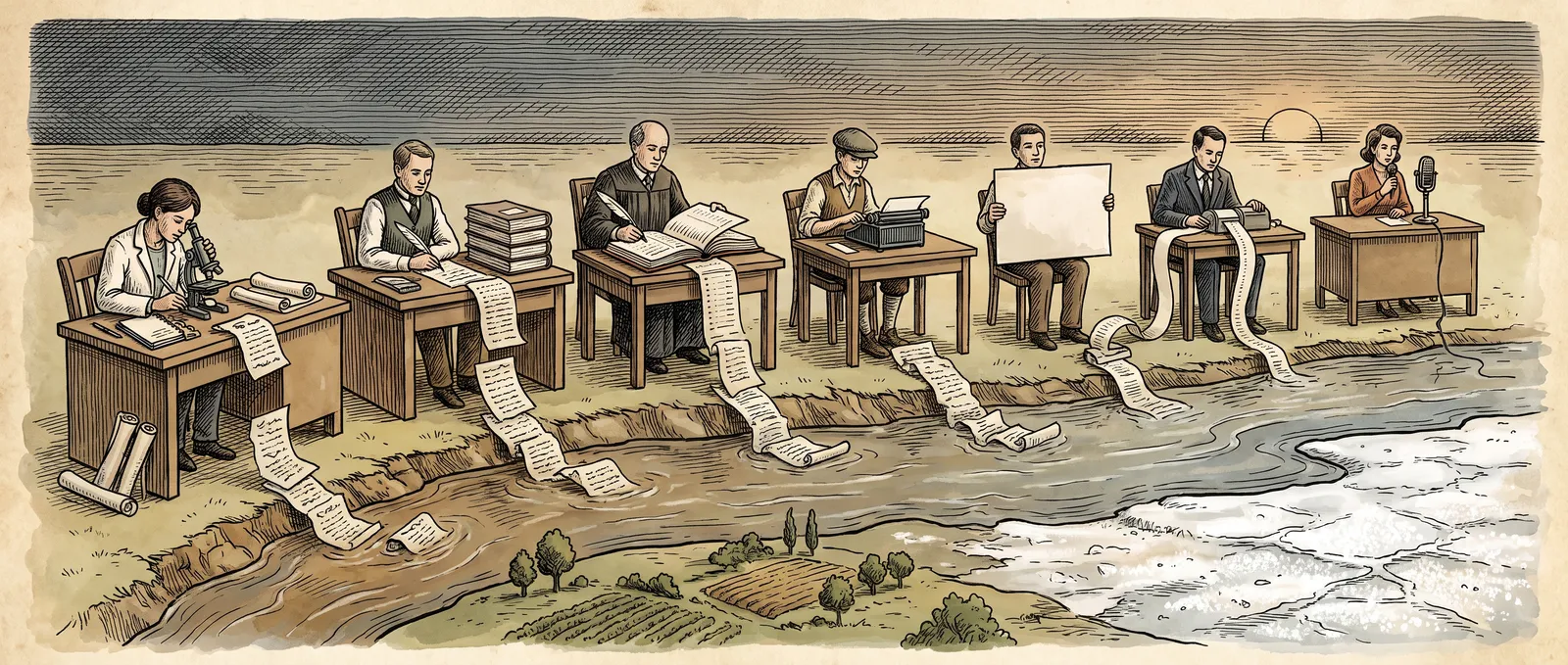
Seven desks on the bank. Seven professions on one bank, each pouring paper into the river. Upstream the flood lays down silt and the fields are green; downstream the water stalls and leaves salt. Full size
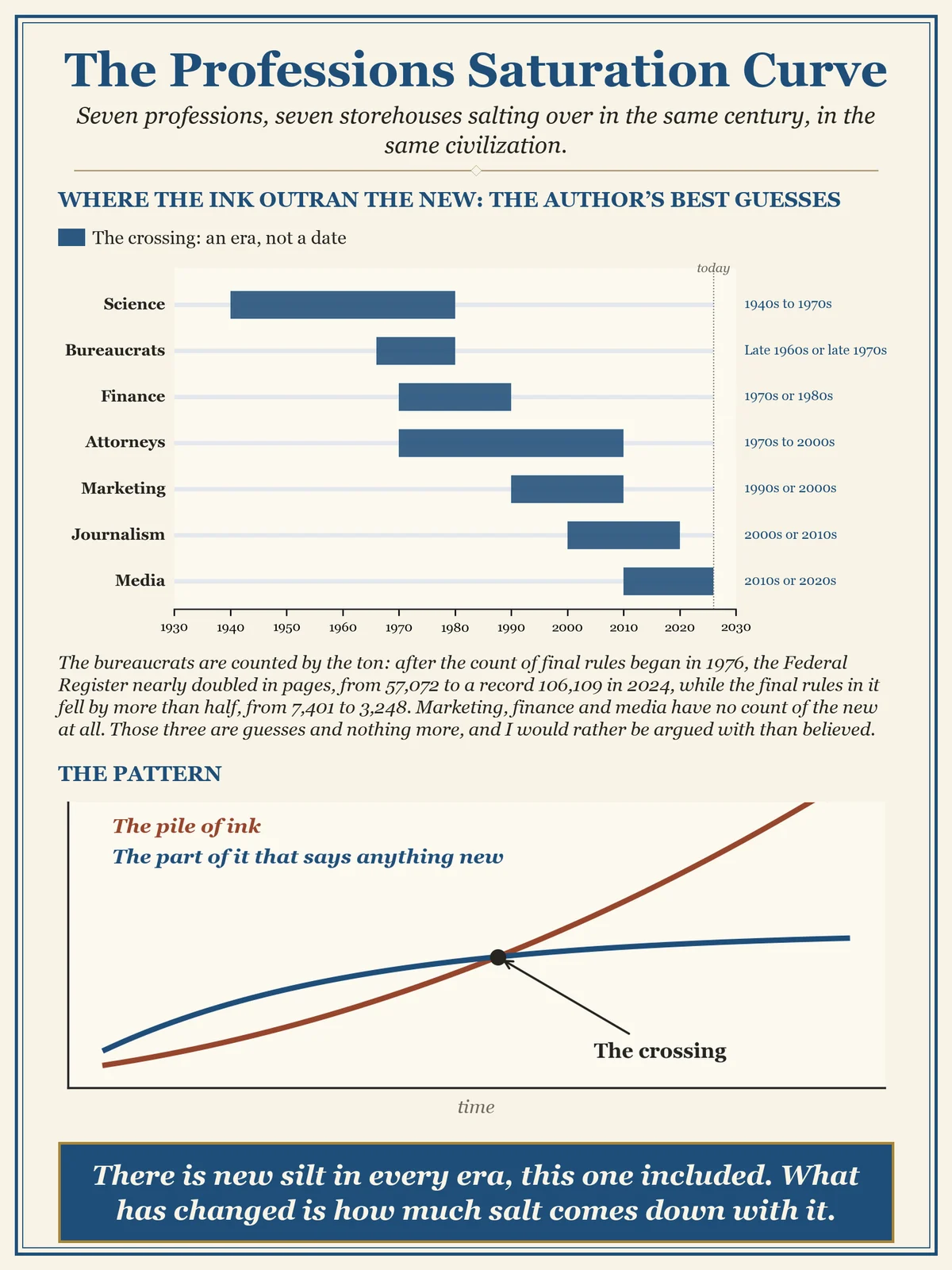
The whole flood is everything a profession writes. The silt is the part of it that is new, and the rest is salt. Set against each other they are the silt to salt ratio: the fertile new ground a flood of writers lays down, against the salt the water leaves when its current stalls. The eras below are the author's best guesses at when the salt outran the silt in each career, each a span of decades and never a year, each shown with the measured series that anchors it and what argues against it.
These are best guesses. No career is given a crossing year. The careers are examples of one pattern, not seven separate findings. The pattern itself, pooled across every measured series, the waves of new writers and new machines, the charts, and every limit the pattern states against itself are on Method: the pattern and the waves, with an open invitation to argue it.
The modern professions
Career
Best-guess crossing era
Measured anchor
What argues against it
Science
somewhere between the 1940s and the 1970sbest guess
Park: the gap already widens from the first point, 1945 (x13.6 by 2010). Bloom: researchers per chip doubling x18, 1971 to 2014
On Holst's data the gap widens only 3 to 14 percent in total over 65 years, against thirteenfold on Park's. Kelly's breakthrough wave runs from 1985. In 2010 the fastest-growing national literatures had the higher disruptive shares. The earlier single date, "1970s", is later than Park's first point allows
Bureaucrats
between the late 1960s and the late 1970sbest guess
Federal Register pages 16,850 (1966) to 57,072 (1976). Pages per final rule 9.5 (1976 to 1983), rising in every eight-year block to 33.0 (2024)
The rule count starts in 1976, so an earlier crossing cannot be seen. Pages fell to 47,418 by 1986. This is the slowest modern series (x1.85 a generation). The earlier single date, "1980s", is later than the data allow
Attorneys
between the 1970s and the 2000sbest guess
Lawyers per public law: 297 (1950s), 631 (1970s), 1,904 (1990s), 3,812 (2020s)
Lawyers per page of statute stay at 114 to 139 in every decade from the 1950s to the 1990s, reach 172 in the 2000s and 212 in the 2010s, then fall back to 157 in the 2020s. On pages the crossing is no earlier than the 2000s; on laws it is the 1950s or before
Journalism
the 2000s to the 2010sbest guess
Novelty side only: daily newsroom jobs 56,900 (1990), 46,700 (2008), 32,900 (2014) (ASNE). 17 percent of stories carried new information in Pew's 2009 Baltimore week
The ink side, the feed, has no series, so no crossing is measured. The newsroom decline begins in 1990, before the web reached the public
Marketing
the 1990s to the 2000sbest guess
None on the novelty side. Ink: ad spend 19,550 million dollars (1970), 129,968 (1990), 279,612 (2007); digital ad revenue 258,600 million (2024)
Ad spend as a share of GDP barely moves: 2.5 percent in 1919, 1.9 in 1950 and 1970, 2.5 in 2000, 2.0 in 2007
Finance
the 1970s to the 1980sbest guess
None on the novelty side. Philippon's unit cost of financial intermediation: 1.77 percent (1970), 2.15 (1980), 2.32 (2000), so more finance per unit of service after the 1970s. Finance's share of GDP: 4.24 percent (1970) to 7.66 (2000)
Cost is not novelty. The share rose as fast from 2.8 percent (1920) to 4.86 (1930), and nobody calls that a crossing
Media
the 2010s to the 2020sbest guess
None: no measure anchors this guess
No measured series on either side. The book's "mid-2020s" is a reading
Earlier careers
Career
Best-guess crossing era
Measured anchor
What argues against it
Scribes of the clay record
none inside the clay recordbest guess
CDLI: the scholarly share rose from Ur III to Neo-Assyrian times
The measured data argue against any crossing inside the record. At Nippur's House F "the majority of them were students' school exercises", which are copies (ink), so part of the rise is school copying and part is what happened to be kept
Copyists and scholars, Islamic world
the 900s to the 1100sbest guess
Chaney: 9.68 percent of books scientific (800 to 1100), 5.1 (1100s), 2.1 (1700s)
The 800 to 1100 base is one bin, so the turn cannot be placed inside it. Chaney reads the fall as a religious revival crowding science out, which is not salt. The pooled 1000 to 1500 era runs x0.98
Printers, Latin Europe
the 1600s to the 1700sbest guess
None: the one measured window, 1477 to 1527, shows no direction
The non-religious share rose from 55 to about 65 percent through 1600, and Britain's 1700s ran the other way
Print trade and inventors, Britain
the 1800s, between the steam press and 1900best guess
None: nothing measures novelty from 1800 to 1950
From 1705 to 1795 patents rose 29 times while titles rose by half. Kelly's breakthrough wave of 1870 to 1880 says the new still ran strong late in the century
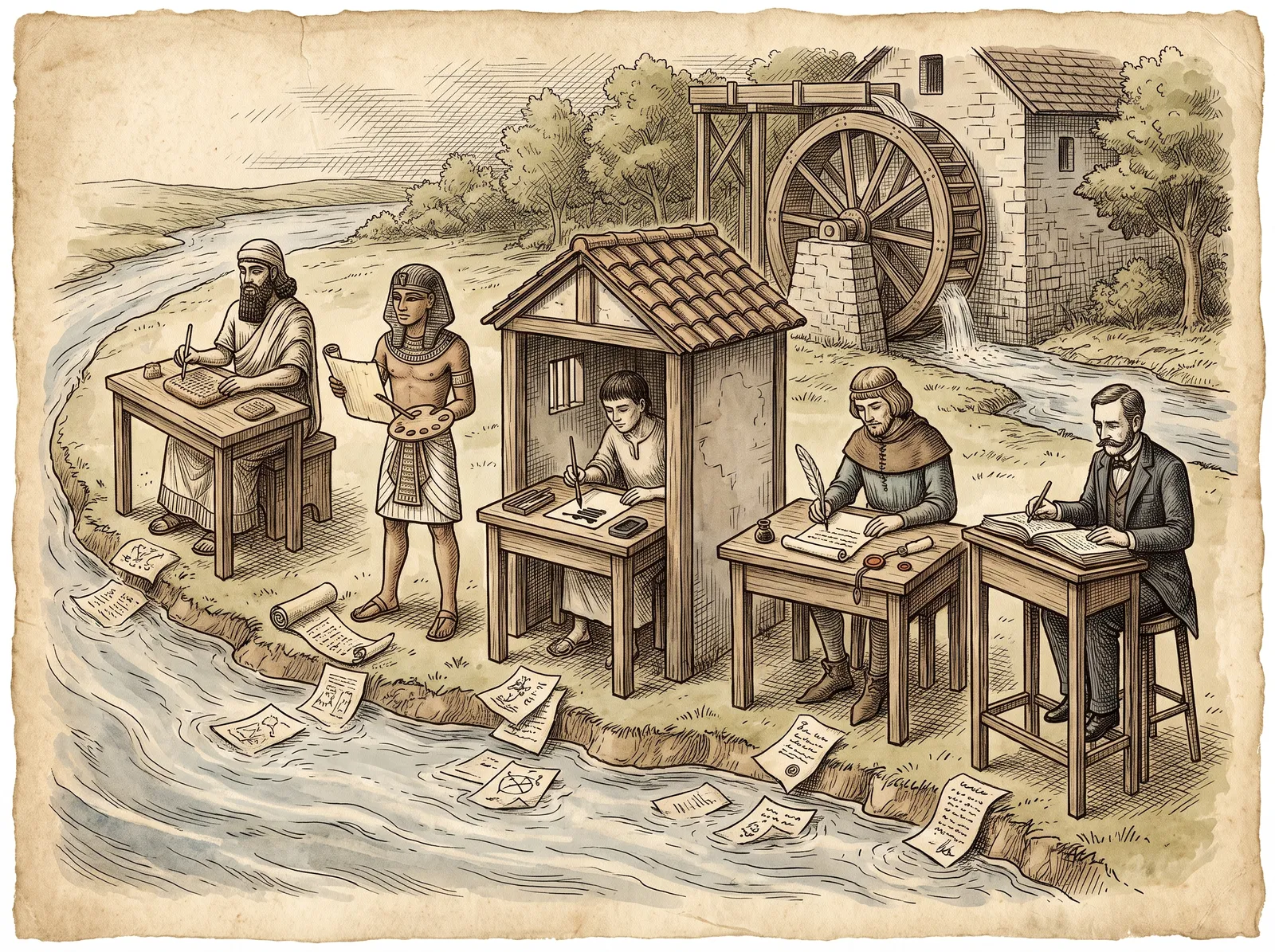
Companion illustration · Chapter 25The earlier careersClay, papyrus, the brush in the examination cell, the notary's seal and the clerk's ledger: the earlier careers, each shedding its paper into the same river.Full size
Each era is a best guess, a span of decades, not a year. Numbers are computed from the profession dataset and the Philippon workbook.
Two of the seven single dates an earlier draft gave (science, bureaucrats) sit later than the measured data allow. The guesses above move them earlier and say so. Three careers (marketing, finance, media) have no novelty series at all, and their eras are the author's reading.
Figure 22 · Ch 25The Professions Saturation CurveThe crossings cluster inside living memory. The author's best guesses, eras and not dates: science, somewhere between the 1940s and the 1970s; bureaucrats, the late 1960s to the late 1970s; finance, the 1970s to the 1980s; attorneys, the 1970s to the 2000s; marketing, the 1990s to the 2000s; journalism, the 2000s to the 2010s; media, the 2010s to the 2020s. Each profession crossed the same threshold: its total output kept climbing while the fraction that said something new about the world fell behind it, the silt to salt ratio sliding toward salt.All plates in the Field Guide · Full size
What the measured data show
No crossing year is claimed here either. Each career is an example of the pattern, or a case against it, by what its measured data show.
Career
What the measured data show
Series
Science
Ink outruns novelty, on two independent measures: papers x13.6 against a flat count of highly disruptive papers, 1945 to 2010; researchers x18 per doubling of chip density, 1971 to 2014. Against: the larger of the two is under a live dispute (Holst), and across twelve countries in 2010 the fastest-growing literatures had the higher disruptive shares
Park, Bloom, Cui
Bureaucrats
Ink outruns novelty on both definitions of ink: Federal Register total pages 57,072 (1976) to 107,262 (2024; Office of the Federal Register, Pages Published Per Category) while final rules fell 7,401 to 3,248; on the CFR stock the gap widens x4.5
OFR
Attorneys
Ink outruns novelty over 1950 to 2022 on both counts of new law (x20.9 on public laws, x1.60 on pages of statutes). Against: in 1950 to 1975 lawyers rose 1.83 times and pages of statutes 1.63 times, which the codebook's rule calls expansion, and in some Congresses pages of statutes grew faster than the bar
ABA, Brookings
Journalism
Half measured. The novelty side fell (newspaper journalists to 0.33 to 0.40 of their 2005 number; 17 percent of stories carried new information in Pew's Baltimore week). The ink side, feed volume, has no clean series. Not scored
Medill, Pew
Marketing
No novelty series. Ad spend is measured; as a share of GDP it barely moved from 1919 to 2007. Not scored
Galbi
Finance
No novelty series. Finance's share of GDP rose 2.81 to 8.25 percent, 1947 to 2006. Not scored
Philippon
Media
No measured series. Not scored
Scribes of the clay record
Novelty outran ink: the scholarly share rose from Ur III to Neo-Assyrian times
CDLI
Copyists and scholars, Islamic world
Ink outran novelty: the scientific share of books fell from 9.68 percent (800 to 1100) to 2.07 (1700s)
Chaney
Printers, Latin Europe
No direction in the one measured window
Febvre and Martin, USTC
Print trade and inventors, Britain
Novelty outran ink: patents rose from 2.2 to 64.7 a year while titles rose from about 1,800 to 2,700
Clio Infra, Bottomley
The long version: five professions Chapter 25 tells short
Chapter 25 walks two professions in full, journalism and the bureaucrats, and tells the other five short. The long walk-throughs below are the book’s own paragraphs as the current edition carried them until 2026-10-21, copied word for word, less one sentence held back until a primary source is found, so the names, dates and numbers that left the page are still here. The book keeps each finding and its hardest fact on the page; only the walk-through moved. The counts under each entry are the best-guess eras in the table above.
The candor line the chapter used to carry in its setup: “Marketing, finance and media have never been counted, and there I read by eye and say so.” The book now says it where each one lives: finance and media in one line (“Finance and media I read by eye, and I say so.”), marketing as “Nobody has ever counted the new in any of it.”
Attorneys entry dated 2026-10-21
What the book keeps. Madison in Philadelphia, May 1787, eleven days early and already read; Morris's Preamble; the four sheets of parchment; the tax law from about 27 pages (1913) to 5,248 pages of statute and a 74,000-page reporter (2013); seven billion hours of compliance; the bar up sixfold from 1950 to 2022 while laws passed fell by more than half; nondisclosure agreements against every state legislature's laws; $137,500 of median debt.
The long walk, as the book carried it until 2026-10-21
Attorneys. Before the ink buried the insight, lawyers were the scribes who built nations. In May 1787, James Madison arrived in Philadelphia eleven days early for the Constitutional Convention and spent every one of them reading. He had got two trunks of books out of Paris by way of Jefferson (Polybius on confederacies, Montesquieu on republics, every account of the Achaean League and the Lycian Federation he could find), worked through them in his father’s house in Orange County, Virginia, and then, in New York that April, compiled a study called “Vices of the Political System of the United States,” the most thorough failure-mode analysis any government had ever received from a thirty-six-year-old Virginia delegate to the Confederation Congress. He was a reader, which in 1787 was a rarer and more dangerous thing. The other delegates arrived to find that Madison had already drafted a framework. Not because he was the smartest man in the room; the room would contain Franklin, Hamilton, Washington, and a thirty-five-year-old Gouverneur Morris whose wooden leg did nothing to slow down his pen or his wit. Because he had read everything. The scribe’s advantage, applied at the constitutional level: the man who had consumed the entire written record of republican governance walked into Independence Hall and handed the other fifty-four delegates the blueprint they would argue over for four months. Morris, who could write the way some men breathe, took Madison’s architecture and gave it a voice. The Preamble, fifty-two words that have governed three hundred million people for nearly two and a half centuries, was Morris’s draft, written for the Committee of Style in the space of four September days. “We the People” reads like a slogan and works like a deed, drafted by a lawyer who understood that the first three words of a constitution determine everything that follows. The lawyer as the carrier whose knowledge built the cave the nation still inhabits, and built it as a cave system: thirteen caves, the tunnels between them written open by a constitution and held open ever since. Madison had read every account of a confederacy that let its tunnels seal, and what he drafted was the machinery to keep them from sealing. The finished Constitution fit on four sheets of parchment.
Then the numbers. The lawyer is the scribe whose output is law about law, and both of his curves have been drawn. There are more attorneys per American than at any time in the country’s history, and the income tax law of 1913, which ran about twenty-seven small pages, had grown by 2013 to 5,248 pages of statute on the same size paper, wrapped in a 74,000-page reporter of regulations and rulings; Americans spend about seven billion hours a year complying with it. The bar grew sixfold between 1950 and 2022 while the number of laws Congress passed fell by more than half. Today there are 1.3 million lawyers in the United States, and a striking number of them are underwater: the median new lawyer owes about $137,500 in student loans, and new associates at midsize firms spend their first years reviewing contracts that a large language model reads faster and more accurately than they do. The profession that produced Madison’s constitutional synthesis and Morris’s Preamble now produces more nondisclosure agreements per year than the total number of laws passed by every state legislature combined. The credential inflated past the work it was designed for. The gate stayed expensive while the treasure behind it quietly salted over, and a generation of bright people walked through it carrying debt into a cave that was already full.
The counts. Best-guess crossing: between the 1970s and the 2000s. Anchor: Lawyers per public law: 297 (1950s), 631 (1970s), 1,904 (1990s), 3,812 (2020s). Against the reading: Lawyers per page of statute stay at 114 to 139 in every decade from the 1950s to the 1990s, reach 172 in the 2000s and 212 in the 2010s, then fall back to 157 in the 2020s. On pages the crossing is no earlier than the 2000s; on laws it is the 1950s or before.
PrimaryCCH (Wolters Kluwer), 'Fact Sheet: 100-Year Tax History: The Length and Legacy of Tax Law' (2013)cch.com/wbot2013/factsheet.pdfOpened 2026-10-21. The Sixteenth Amendment and the Revenue Act of 1913 'were approximately 27 pages in length, and the pages measured six by nine inches'; 'the 2013 Winter Edition of the U.S. Internal Revenue Code contains 5,248 pages. It is also printed on the six by nine inch paper' of 1913; the CCH Standard Federal Tax Reporter is 'a 73,954 page, 25-volume service'.
PrimaryAccessLex Institute and ABA Young Lawyers Division, 2024 Student Loan Surveyaccesslex.org/sites/default/files/2024-09/2024-ABA-YL…p. 7: 'Those who borrowed for law school reported median amounts of $112,500 in J.D. loans and $137,500 in all loans at graduation.' The sample is young lawyers who borrowed.
There are more attorneys per American than at any time in the country’s history, and the income tax law of 1913, which ran about twenty-seven small pages, had grown by 2013 to 5,248 pages of statute on the same size paper, wrapped in a 74,000-page reporter of regulations and rulings; Americans spend about seven billion hours a year complying with it.
ABA resident-active counts (2025 NLPS p. 20) against Census population: about 1 lawyer per 243 Americans for the 2019 count (1,350,864 vs 328.2 million), about 1 per 248 for 2025 (1,374,720 vs about 341 million). The per-capita figure peaked with the 2017 to 2020 counts and is now just below that peak, though far above any year before 2000 (1951: 1 per 695, ABF Table 1). 'More than at any time' overstates it;The tax-code half is sourced on f5-a11 / f5-u3.
The Preamble, fifty-two words that have governed three hundred million people for nearly two and a half centuries, was Morris’s draft, written for the Committee of Style in the space of four September days.
Preamble is 52 words (National Archives transcription); drafted by Morris for the Committee of Style, Sept. 8–12, 1787 (Farrand II pp. 547, 590; III p. 499); US population 341.8 million in 2025 (Census Bureau), i.e. over three hundred million; 1787–2026 is ~239 years. The book now says nearly two and a half centuries. Re-quoted (earlier wording: 'The Preamble, fifty-two words that have governed three hundred million people for two and a half centuries, was Morris’s draft, written for the Committee of Style in the space of four September days.'). On 2026-10-21 the book told the attorneys story more briefly: this sentence left the book then and is on this site's Professions page, word for word, in the attorneys entry.
PrimaryMax Farrand (ed.), The Records of the Federal Convention of 1787, vol. II (New Haven: Yale University Press, 1911) — Internet Archivearchive.org/details/nislu.342.7302.far-ii.32659/pag…p. 547 (Journal, Sept. 8) and p. 590 (Report of Committee of Style):Journal, Sept. 8, 1787 (p. 547): Committee 'of five to revise the style of and arrange the articles' appointed by ballot — Johnson, Hamilton, G. Morris, Madison, King; Journal, Sept. 12: Johnson 'from the Committee of revision' reports the Constitution; 'Report of Committee of Style' (p. 590) opens 'WE, the People of the United States, in order to form a more perfect union...'.
worked through them in his father’s house in Orange County, Virginia
Papers of Madison: the confederacy research was done 'in his Montpelier library' in spring–summer 1786, 'the last time that JM was at home with his books'; Montpelier was the estate of his parents James Madison Sr. and Nelly Conway Madison in Orange County, Virginia (Miller Center). On 2026-10-21 the book told the attorneys story more briefly: this sentence left the book then and is on this site's Professions page, word for word, in the attorneys entry.
Reference'The Life of James Madison', James Madison's Montpelier (Montpelier Foundation)montpelier.org/learn/the-life-of-james-madison'At his father's death in 1801, Madison inherited Montpelier and the 100-plus enslaved African Americans who came with it.'; 'Madison did much of his research and writing at Montpelier.' (read via WebFetch, 2026-10-25)
a thirty-six-year-old Virginia delegate to the Confederation Congress
Born March 16, 1751 (Miller Center), so 36 in spring 1787; he 'returned to Congress in February' 1787 (Papers of Madison) and was 'representing Virginia in the Confederation Congress' in New York when he left for Philadelphia (Stewart). On 2026-10-21 the book told the attorneys story more briefly: this sentence left the book then and is on this site's Professions page, word for word, in the attorneys entry.
The other delegates arrived to find that Madison had already drafted a framework
Papers of Madison: Madison's spring-1787 letters to Jefferson, Randolph and Washington 'were the basis of those resolutions submitted by Governor Randolph to the convention on 29 May 1787 which became known in history as the Virginia Plan'; he arrived well before the others (Stewart) and worked his ideas up with the Virginia delegation (Miller Center). On 2026-10-21 the book told the attorneys story more briefly: this sentence left the book then and is on this site's Professions page, word for word, in the attorneys entry.
the room would contain Franklin, Hamilton, Washington
National Archives delegate roster lists Benjamin Franklin (Pa.), Alexander Hamilton (N.Y.) and George Washington (Va.); Washington was unanimously elected president of the convention (Bruns, A More Perfect Union). Delegate William Pierce's contemporaneous character sketches (Farrand, Records III, pp. 89, 91, 94) describe all three in the room. On 2026-10-21 the book told the attorneys story more briefly: this sentence left the book then and is on this site's Professions page, word for word, in the attorneys entry.
Reference'Meet the Framers of the Constitution' — National Archives, America's Founding Documentsarchives.gov/founding-docs/founding-fathersDelegate list incl. Benjamin Franklin and Gouverneur Morris (Pa.), Alexander Hamilton (N.Y.), George Washington and James Madison Jr. (Va.); 'In all, 55 delegates attended the Constitutional Convention sessions'; Assembly Room of the Pennsylvania State House, 'later named Independence Hall'.
PrimaryMax Farrand (ed.), The Records of the Federal Convention of 1787, vol. III (New Haven: Yale University Press, 1937 rev. ed.) — Internet Archivearchive.org/details/in.ernet.dli.2015.58320/page/89pp. 89, 91, 94:Doc. CXIX, William Pierce (Ga. delegate), 'Character Sketches of Delegates to the Federal Convention': p. 89 'From New York. Alexander Hamilton, [Robert] Yates, and W. [John] Lansing ... Colo. Hamilton is deservedly celebrated for his talents'; p. 91 'Dr. Franklin is well known to be the greatest phylosopher of the present age'; p. 94 'Genl Washington is well known as the Commander in chief of the late American Army ... he now appears to assist in framing a Government'. Also doc. XXIII, George Mason to George Mason Jr., Philadelphia, May 27, 1787 (p. 28): 'Nothing was done yesterday but unanimously appointing General Washington President'. Appendix B lists delegates, credentials and attendance.
Today there are 1.3 million lawyers in the United States
ABA National Lawyer Population Survey: 1,322,649 resident active lawyers in 2024 (2023-24 NLPS, p. 12); 1,374,720 in 2025 (2025 NLPS, p. 20). 'More than 1.3 million' holds; 1.37 million in 2025. On 2026-10-21 the book told the attorneys story more briefly: this sentence left the book then and is on this site's Professions page, word for word, in the attorneys entry.
What the book keeps. The whole Ch 25 paragraph stays on the page as it was: "Finance and media I read by eye, and I say so."; Philippon's 2.5 percent of GDP in 1947 against almost 8 percent by 2006; a cent and a half to two cents a year on every dollar, across a hundred and thirty years; roughly forty percent of domestic corporate profits at the early-2000s peak; Richard Whitney, holding the keys to the Exchange.
The book’s paragraph, which stays on the page
Finance. Finance and media I read by eye, and I say so. The scribes won that one completely: money is their work now, and nobody has counted the new in what they write about it. The ink, at least, has been counted. Thomas Philippon put finance at 2.5 percent of American GDP in 1947 and almost 8 percent by 2006, and when he priced the work itself across a hundred and thirty years, the industry was charging a cent and a half to two cents a year on every dollar it handled (Philippon, 2008; Philippon, 2015). The share tripled. The price of moving a dollar did not come down. At its peak in the early 2000s, roughly forty percent of American domestic corporate profits flowed to an industry that moves money but builds nothing. What the count cannot show, one man’s career already has: Richard Whitney, holding the keys to the Exchange and to the fund it paid its dead members’ families.
The counts. Best-guess crossing: the 1970s to the 1980s. Anchor: None on the novelty side. Philippon's unit cost of financial intermediation: 1.77 percent (1970), 2.15 (1980), 2.32 (2000), so more finance per unit of service after the 1970s. Finance's share of GDP: 4.24 percent (1970) to 7.66 (2000). Against the reading: Cost is not novelty. The share rose as fast from 2.8 percent (1920) to 4.86 (1930), and nobody calls that a crossing.
What the book keeps. Bill Bernbach, 1959, the Volkswagen, Helmut Krone and Julian Koenig, "Think Small," the factory whose wartime workforce had been two-thirds forced labor; "The reader is not stupid. The reader knows the car is small."; content strategy by the mid-2000s and the diploma-mill line; the white paper written to capture an email address (called back later in the chapter); that nobody has counted the new in it; "Nobody in the business has written two better words since, and the business has never written more of them."
The long walk, as the book carried it until 2026-10-21
Marketing. In 1959, a Jewish adman from the Bronx named Bill Bernbach did something the advertising industry had never seen and has never successfully repeated. He sold a German car to postwar America by telling the truth. The Volkswagen Beetle was small, strange-looking, and manufactured by a company whose factory had run on forced labor through the war. Every rule in the business said you buried that. You shot the car on a mountain road with a beautiful woman in the passenger seat and you wrote copy about freedom and the open highway and you never, under any circumstances, reminded the buyer that this particular automobile came from the same country that had recently tried to exterminate the copywriter’s relatives. Bernbach looked at the car. It was small. His art director, Helmut Krone, put it in the middle of a white page with acres of empty space around it, and his copywriter, Julian Koenig, wrote two words at the top: “Think Small.” It was the most successful print ad in the history of the industry, and it worked because Bernbach understood something about the relationship between a scribbler and a reader that the rest of Madison Avenue had forgotten: respect. The reader is not stupid. The reader knows the car is small. Lying about it insults the reader, and an insulted reader does not buy. Across town, David Ogilvy was writing the Rolls-Royce headline, “At 60 miles an hour the loudest noise in this new Rolls-Royce comes from the electric clock,” a sentence he had lifted from a British motoring review and polished into the most elegant piece of product copy ever published. These were people who moved culture with language. Not with data. Not with targeting. With the quality of what they wrote. Two words from a Jewish adman’s shop sold postwar America a car out of a factory whose wartime workforce had been two-thirds forced labor.
The crossing came with the internet, and it came fast. By the mid-2000s, the craft that produced “Think Small” had been replaced by content strategy, which is to copywriting what a diploma mill is to a university: it borrows the vocabulary and produces the volume without the thing that made the original valuable. They produce blog posts optimized for search-engine keyword density, social media captions tested against each other for a hair’s improvement in click-through, and white papers whose primary purpose is to capture an email address. The whole flood has never been higher. The silt, the fraction of marketing output that says something a reader had not already heard, approaches zero. The profession that created cultural moments now optimizes for algorithms, and the algorithms do not care whether the copy is good. They care whether it is clicked. Nobody in the business has written two better words since, and the business has never written more of them.
The counts. Best-guess crossing: the 1990s to the 2000s. Anchor: None on the novelty side. Ink: ad spend 19,550 million dollars (1970), 129,968 (1990), 279,612 (2007); digital ad revenue 258,600 million (2024). Against the reading: Ad spend as a share of GDP barely moves: 2.5 percent in 1919, 1.9 in 1950 and 1970, 2.5 in 2000, 2.0 in 2007.
Sources on the site: AMA/BLS employment data 2024; Digital Silk/GoAdFuel; Coen Dataset
Across town, David Ogilvy was writing the Rolls-Royce headline, “At 60 miles an hour the loudest noise in this new Rolls-Royce comes from the electric clock,” a sentence he had lifted from a British motoring review and polished into the most elegant piece of product copy ever published.
Ogilvy, Confessions (1963), pp. 106–107, cites his Rolls-Royce headline; Ogilvy on Advertising (1983): 'I spent three weeks reading about the car and came across a statement that "at sixty miles an hour, the loudest noise comes from the electric clock." This became the headline'; the ad itself credits 'the Technical Editor of THE MOTOR' (British motoring weekly); Fox (Faber, 1984) traces the thought to The Autocar's 1907 Silver Ghost review. On 2026-10-21 the book told the marketing story more briefly: this sentence left the book then and is on this site's Professions page, word for word, in the marketing entry.
BookDavid Ogilvy, Confessions of an Advertising Man (New York: Atheneum, 1963) — Internet Archivearchive.org/details/confessionsofadv0000daviCh. 6 'How to Write Potent Copy', pp. 106–107: Ogilvy cites his headline 'At Sixty Miles an Hour the Loudest Noise in the New Rolls-Royce comes from the electric clock', with footnote that the Rolls-Royce chief engineer replied 'It is time we did something about that damned clock' (index: 106-7). (text located via Internet Archive full-text search; lending-library item)
BookDavid Ogilvy, Ogilvy on Advertising (New York: Vintage Books, 1985; first publ. Crown, 1983) — Internet Archivearchive.org/details/ogilvyonadvertis0000ogilOgilvy's own account (scan leaf 230; printed page not visible): 'When I got the Rolls-Royce account, I spent three weeks reading about the car and came across a statement that "at sixty miles an hour, the loudest noise comes from the electric clock." This became the headline'; the ad reproduction on the same spread reads '"At 60 miles an hour the loudest noise comes from the electric clock," reports the Technical Editor of THE MOTOR'. Text located via Internet Archive/Open Library search-inside; lending-library item.
It was the most successful print ad in the history of the industry
Advertising Age's 'Advertising Century' (Bob Garfield, 29 Mar 1999) ranked DDB's Volkswagen work #1, 'the greatest advertising campaign of the century'. Strictly the ranking is for the campaign, not the single ad. On 2026-10-21 the book told the marketing story more briefly: this sentence left the book then and is on this site's Professions page, word for word, in the marketing entry.
What the book keeps. One line, set where media lives, right after the zoning story in the journalism section: "That is the seventh profession on the list, media, and it moved into the first one’s building and kept the masthead." Then one counted fact: between 2008 and 2020, by Pew's count, newspaper newsrooms lost 57 percent of their jobs while digital-native newsrooms went from about 7,400 to about 18,000. Then the candor: nobody has counted how much of what the new ones publish is new. Finance's paragraph carries "Finance and media I read by eye, and I say so."
The long case. Media is journalism's building with a different business inside it. Pew Research Center, reading the Bureau of Labor Statistics' Occupational Employment and Wage Statistics for 2008 to 2020 (Mason Walker, "U.S. newsroom employment has fallen 26% since 2008," 13 July 2021): total newsroom employment, meaning reporters, editors, photographers and videographers across newspapers, radio, broadcast television, cable and digital-native publishers, fell from about 114,000 to about 85,000. Newspaper newsrooms fell 57 percent, from roughly 71,000 to about 31,000. Digital-native newsrooms rose 144 percent, from 7,400 to about 18,000, and went from 6 percent of all newsroom jobs to 21 percent. Broadcast television held near 28,000. That is the move into the first one's building: the masthead stayed, and the people under it changed trades. What nobody has counted is the other curve, the share of what the feed carries that is new.
The counts. Best-guess crossing: the 2010s to the 2020s. Anchor: None: no measure anchors this guess. Against the reading: No measured series on either side. The book's "mid-2020s" is a reading.
What the book keeps. "Science, where the count is best."; "Research had not stopped. Research had thickened."; roughly a quarter of tenure-track faculty with a parent who holds a doctorate, and "No faculty meeting ever voted for it."; Park, Leahey and Funk, Nature, 2023, 45 million papers and 3.9 million patents, the disruptive count flat from 1945 to 2010 and the average paper's disruptiveness down 92 to 100 percent; the flat line and the machine; the Open Science Collaboration's 36 percent (2015) and Serra-Garcia and Gneezy (2021), "salt winning a popularity contest"; more than ten thousand retractions in 2023 (Van Noorden, 2023) and "A sham paper is salt made on purpose."; the view from inside, verbatim. Bloom, Jones, Van Reenen and Webb (American Economic Review, 2020, "everywhere they looked") now arrive in the paragraph that argues with their reading.
The long walk, as the book carried it until 2026-10-21
Science, where the count is best. Somewhere after the war, as near as I can place it, the salt outruns the silt in science, and the crossing is easier to feel than to prove, because everyone inside the system felt it before anyone measured it. Research had not stopped. Research had thickened. The number of papers climbed and the number of things a working scientist could name that had been settled in the past decade did not climb with it. Departments grew. Journals multiplied. Conferences filled hotels. And the professoriate began, quietly and without anybody deciding it, to reproduce itself the way the edubba reproduced itself and the way the Chinese examination halls reproduced themselves: from the inside. A striking share of American university professors turned out to be the children of university professors: roughly a quarter of tenure-track faculty in the United States have at least one parent with a doctorate, and at the most selective departments the concentration is sharper still. No faculty meeting ever voted for it, and no cabal arranged it; it is what a protected niche does when the entry cost rises faster than the payoff: the people who can afford the entry cost are increasingly the people who were raised inside.
Science now had more literate hands than it had questions to put them to, and it answered the way every saturated system in this book has answered: not by producing less, but by producing more, about itself, at higher volume, for a smaller audience. What went flat was the count of breakthroughs. Park, Leahey, and Funk measured it in Nature in 2023, across 45 million papers and 3.9 million patents: from 1945 to 2010 the number of truly disruptive papers and patents stayed nearly constant while the total climbed year after year, so the average paper’s disruptiveness fell by 92 to 100 percent depending on the field, and the average patent’s by 79 to 92 percent between 1980 and 2010. The flat line ran for more than sixty years, and it is the last thing the measurements show before the invention of a machine that could read everything the flat line had produced in an afternoon.
Science is all the professions that discover, and its two curves are the best drawn. Ten scientific journals existed in the late seventeenth century; since 1952 the literature has doubled about every fourteen years. Lately it has stopped waiting fourteen years: Scopus and Web of Science indexed about 47 percent more articles in 2022 than in 2016, while the number of working scientists grew little if at all, and the publishers growing fastest did it with special issues on shortened review (Hanson et al., 2024). The ink sped up. The scribes did not. Bloom, Jones, Van Reenen, and Webb asked in the American Economic Review in 2020 whether ideas are getting harder to find, and the answer was yes, everywhere they looked. When the Open Science Collaboration reran a hundred published psychology studies in 2015, only 36% replicated, and Serra-Garcia and Gneezy found in 2021 that the ones that failed were cited more often than the ones that held, and kept being cited after the failure was published, which is salt winning a popularity contest. The bench says the same. When 1,576 researchers were polled in 2016, more than 70 percent had tried and failed to reproduce another scientist’s experiment, and more than half had failed to reproduce their own (Baker, 2016). In 2023 the journals retracted more than ten thousand papers, smashing every annual record, as publishers scrambled to clean out sham papers and rigged peer review (Van Noorden, 2023). A sham paper is salt made on purpose. The rest of the counts sit on the professions page for anyone who wants to check my arithmetic. Science is the one profession whose product is the new, and in the Nature count the new held flat for sixty-five years while the papers kept coming.
The counts. Best-guess crossing: somewhere between the 1940s and the 1970s. Anchor: Park: the gap already widens from the first point, 1945 (x13.6 by 2010). Bloom: researchers per chip doubling x18, 1971 to 2014. Against the reading: On Holst's data the gap widens only 3 to 14 percent in total over 65 years, against thirteenfold on Park's. Kelly's breakthrough wave runs from 1985. In 2010 the fastest-growing national literatures had the higher disruptive shares. The earlier single date, "1970s", is later than Park's first point allows.
Sources on the site: Bloom/Jones/Van Reenen/Webb (AER 2020); Jones (RES 2009); OSC (Science 2015); Begley & Ellis (Nature 2012); Baker (Nature 2016); NSF NCSES; Hanson et al. (arXiv 2023); Bornmann, Haunschild and Mutz 2021: https://doi.org/10.1057/s41599-021-00903-w
Ten scientific journals existed in the late seventeenth century; since 1952 the literature has doubled about every fourteen years.
NSB-2023-33 (NCSES): 'Global publication output reached 3.3 million articles in 2022, based on data from the Scopus database'; Bornmann, Haunschild & Mutz 2021: overall growth rate 4.10% 'with a doubling time of 17.3 years'. On 2026-10-21 the book told the science story more briefly: this sentence left the book then and is on this site's Professions page, word for word, in the science entry.
Ten scientific journals existed in the late seventeenth century; since 1952 the literature has doubled about every fourteen years.
Scholars disagree. Derek de Solla Price's curve, followed by Ghasemi et al. (2023), puts scholarly journals at about 10 at the end of the seventeenth century; Tenopir and King (2009) estimate about 30 to 90 science periodicals in 1700. On 2026-10-21 the book told the science story more briefly: this sentence left the book then and is on this site's Professions page, word for word, in the science entry.
BookDerek J. de Solla Price, Little Science, Big Science... and Beyond (New York: Columbia University Press, 1986) — Internet Archivearchive.org/details/little-science-big-science-and-…Ch. 1, p. 8, Fig. 1.1 'Total Number of Scientific Journals and Abstract Journals Founded, as a Function of Date' (from Price, Science Since Babylon, Yale 1961) — the log curve behind the 'ten journals' figure; caption warns counts are for 'all periodicals containing any "science"' and 'Tighter definitions might reduce the absolute numbers by an order of magnitude'.
Science is the one profession whose product is the new, and in the Nature count the new held flat for sixty-five years while the papers kept coming.
1945 to 2010 is sixty-five years. The measure is contested (dataset artefact critique, arXiv 2402.14583), which the book's Notes already concede. On 2026-10-21 the book told the science story more briefly: this sentence left the book then and is on this site's Professions page, word for word, in the science entry.
Ten scientific journals existed in the late seventeenth century; since 1952 the literature has doubled about every fourteen years.
Ten journals is fine. Seventeen years is the average over three and a half centuries, not the rate "now"; the same paper puts the current phase at about fourteen years. On 2026-10-21 the book told the science story more briefly: this sentence left the book then and is on this site's Professions page, word for word, in the science entry.
Scopus and Web of Science indexed about 47 percent more articles in 2022 than in 2016
Hanson et al.: 'in 2022 the article total was approximately ~47% higher than in 2016, which has outpaced the limited growth, if any, in the number of practising scientists'; some publishers grew by 'hosting special issues, which publish articles with reduced turnaround times.' The 5.6%-a-year figure in older drafts appears only in secondary summaries and is not used. On 2026-10-21 the book told the science story more briefly: this sentence left the book then and is on this site's Professions page, word for word, in the science entry.
When 1,576 researchers were polled in 2016, more than 70 percent had tried and failed
Nature's survey of 1,576 researchers: 'More than 70% of researchers have tried and failed to reproduce another scientist's experiments, and more than half have failed to reproduce their own experiments.' On 2026-10-21 the book told the science story more briefly: this sentence left the book then and is on this site's Professions page, word for word, in the science entry.